




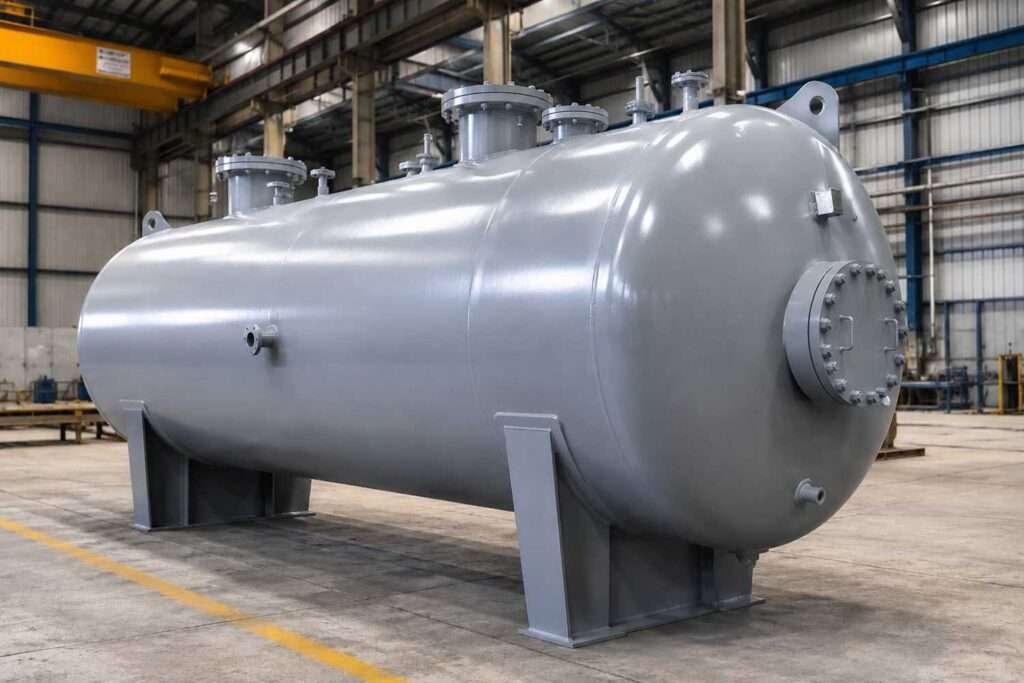
When industrial equipment needs to hold pressure safely, the quality of the pressure vessel matters from the start. It must also work reliably in tough conditions. Design calculations, material selection, welding, inspection, testing, documentation and certification all have to work together.
As an experienced engineering and fabrication company serving industrial customers, Anpam Engineering provides pressure vessel solutions for many applications. We serve clients across the UAE and other international markets. Our approach combines project-specific engineering, controlled fabrication practices, and inspection requirements. This delivers vessels suited to the process, operating conditions, and the applicable design code.
Whether you require a standard process vessel or custom pressure vessels designed around a specific application, choosing the right manufacturer is important. The vessel should not simply match a required volume or pressure rating; it must be engineered for the complete duty.
Engineered Pressure Vessels for UAE Industries
Industrial facilities in the UAE operate in many sectors. These include oil and gas, petrochemicals, power generation, water treatment, chemicals, manufacturing, and food processing. They also include other process industries. Each application can impose different requirements on pressure, temperature, corrosion resistance, materials and vessel configuration.
This is why you should treat pressure vessel manufacturing as an engineering project rather than a simple fabrication job.
A properly engineered vessel may require consideration of design pressure, design temperature, corrosion allowance, material properties, vessel orientation, nozzle loads, support arrangements, internal components, external pressure conditions and inspection requirements.
At Anpam Engineering, we develop pressure vessel requirements based on real service conditions and project specifications. This helps ensure the finished equipment is practical to install and operate.
Custom Pressure Vessels Designed Around Your Process
Not every process application can be addressed with an off-the-shelf vessel. Different industries may require different dimensions, configurations, materials, connections and internal arrangements.
We can engineer our custom pressure vessels to meet specific process requirements, including horizontal and vertical configurations and application-specific nozzle and support arrangements.
Depending on the project, design considerations may include:
- Operating and design pressure
- Operating and design temperature
- Vessel volume and dimensions
- Material of construction
- Corrosion allowance
- Internal coils, distributors or other components
- Nozzle orientation and size
- Saddle, skirt or leg supports
- Insulation and cladding requirements
- Inspection and non-destructive examination
- Hydrostatic or other specified testing
- Project documentation and certification
The objective is not simply to manufacture a vessel that meets a dimensional specification. It is intended to deliver equipment that aligns with the plant’s process needs and meets all engineering specifications and requirements.
ASME U Stamp Pressure Vessel UAE
For projects that require ASME certification, selecting a manufacturer with the appropriate certification capability is especially important.
ASME BPVC Section VIII, Division 1 sets requirements for pressure vessel design, fabrication, inspection, testing, and certification. It applies to vessels operating at internal or external pressures above 15 psig. The code also addresses materials, welding, examination and other construction requirements.
An ASME U Stamp pressure vessel is therefore not simply a vessel carrying a mark. The certification is connected to a controlled manufacturing and quality system operated in accordance with the applicable ASME requirements. ASME’s certification program specifically covers pressure-vessel manufacturers under Section VIII, Division 1 through the U certification scope.
For UAE projects, the client, consultant, EPC contractor, or end user may require ASME compliance. The manufacturer must manage these project requirements. The manufacturer must handle engineering, fabrication, inspection, and documentation.
An U Stamp pressure vessel UAE project may involve detailed review of drawings, material certificates, welding procedures, welder qualifications, examinations, testing and final documentation. The exact requirements depend on the applicable code, project specification and certification scope.
Why Choose an ASME Vessel Manufacturer in UAE Projects?
When sourcing pressure equipment internationally, technical capability and documentation are just as important as price.
An ASME vessel manufacturer UAE buyers can rely on should understand that a pressure vessel is part of a larger process system. The vessel must interface correctly with piping, instruments, valves, foundations and other plant equipment.
A qualified manufacturing partner can help reduce problems related to:
- Inadequate material selection
- Incorrect nozzle positioning
- Insufficient corrosion allowance
- Welding and fabrication inconsistencies
- Incomplete inspection records
- Documentation gaps
- Transportation and installation constraints
- Non-compliance with project specifications
For EPC projects and industrial plants in the UAE, this level of attention can make procurement smoother. It can also make project coordination easier.
Pressure Vessel Fabrication UAE
Pressure vessel fabrication UAE projects require more than forming shells and welding components together. Fabrication quality has a direct relationship with the integrity and reliability of the finished vessel.
A controlled fabrication process generally starts with approved engineering documentation and material verification. Plate and other pressure-retaining materials are identified and processed according to the project requirements. Fabrication then progresses through forming, fit-up, welding, inspection and testing stages.
Welding is particularly important because pressure-retaining welds must meet the applicable design and quality requirements. Depending on the vessel and project specification, inspection may include visual examination and non-destructive examination methods such as radiography, ultrasonic testing, magnetic particle testing or dye penetrant testing.
Testing and inspection requirements are established according to the applicable code and project specifications. ASME Section VIII includes provisions relating to inspection, examination and acceptance criteria as part of pressure-vessel construction.
The final documentation package can also be an important part of project acceptance. Depending on contractual requirements, documentation may include material certificates, fabrication records, welding documentation, inspection reports, test certificates and applicable certification records.
Types of Pressure Vessels We Can Support
Industrial pressure vessels vary significantly according to their service and process duty. The correct configuration depends on pressure, temperature, fluid characteristics, volume and installation requirements.
Typical applications can include:
Process Pressure Vessels
Process vessels are used for holding, separating, mixing or conditioning process fluids and gases. They are commonly found in chemical, petrochemical, manufacturing and other process facilities.
Separators
Separators are designed to separate phases such as gas and liquid or different liquid components. Internal arrangements can be configured according to the process requirement.
Storage and Buffer Vessels
Some systems require vessels to provide storage capacity, buffering or surge control. Their dimensions and pressure ratings are determined by the operating conditions of the installation.
Reactors
Where process reactions occur under controlled pressure and temperature, reactors may require specialized materials, internal components and additional engineering considerations.
Air and Gas Receivers
Compressed-air and gas systems may use receivers to provide storage capacity, stabilize pressure and accommodate variations in demand.
Vertical and Horizontal Vessels
The vessel orientation is selected according to process requirements, available plant space, access requirements and support arrangements.
Materials and Design Considerations
Material selection is one of the most important stages of pressure vessel engineering. The material must be appropriate for the pressure, temperature, and the specific process environment.
Depending on the application, you may consider carbon steel, stainless steel, and other specialized materials. Evaluate factors such as corrosion, erosion, temperature, fluid compatibility, and expected service life before you finalize the material of construction.
The vessel geometry also affects the design. Engineering calculations and service requirements, rather than appearance alone, determine the shell diameter, shell thickness, head configuration, nozzle arrangements, and supports.
For demanding applications, consider external pressure, thermal cycling, vacuum conditions, and loads from connected piping.
Quality and Inspection at Every Stage
A pressure vessel should be traceable throughout its manufacturing journey.
Quality control begins with verification of incoming materials and continues through fabrication, welding, inspection and final testing. Maintaining appropriate records helps demonstrate that the manufacturer built the vessel according to the approved requirements.
For projects requiring ASME certification, the manufacturing and quality-control system must align with the applicable ASME certification requirements. ASME explains that its BPVC certification program addresses the design, fabrication, assembly and inspection controls associated with certified pressure-equipment manufacturing.
For customers, this means they gain greater visibility into how the manufacturer built and inspected the equipment.
Pressure Vessel Suppliers in UAE for Industrial Projects
Finding dependable Pressure Vessel Suppliers in UAE is often about more than locating the lowest quotation. A suitable supplier should be able to understand the application, review specifications, clarify technical requirements and coordinate the manufacturing process with the project schedule.
For UAE customers, practical considerations can include equipment dimensions, delivery requirements, installation access, documentation, inspection arrangements and coordination with EPC contractors or consultants.
A supplier with export project experience can be valuable. This helps when equipment is made outside the UAE. It also helps when it is supplied to a UAE project. Clear communication between engineering, procurement, fabrication, inspection and logistics teams helps reduce avoidable delays.
Why Anpam Engineering?
Anpam Engineering approaches pressure vessel manufacturing with an engineering-led mindset. We support customers who require pressure equipment developed around actual process and project conditions rather than generic catalogue specifications.
Our capabilities include pressure vessels and other engineered process equipment. We serve oil and gas, petrochemicals, power generation, chemicals, manufacturing, and heavy engineering.
For projects requiring certified construction, we align our engineering and fabrication capabilities with applicable ASME requirements and project specifications.
The current ASME BPVC includes Section VIII rules for pressure vessels. Division 1 covers construction and certification rules for these vessels.
Our focus is on combining engineering accuracy, manufacturing control, inspection and practical project coordination to support reliable equipment delivery.
Applications Across UAE Industries
Pressure vessels can support many industrial processes throughout the UAE, including:
Oil & Gas: separators, process vessels, gas systems and associated pressure equipment.
Petrochemical & Chemical: reactors, process vessels, storage vessels and specialized equipment.
Power Generation: auxiliary pressure systems, receivers and process-related vessels.
Manufacturing: compressed-air systems, process vessels and utility applications.
Water and Process Treatment: vessels used in treatment, filtration and process systems.
Food & Beverage: process applications where the selected materials and hygiene requirements are appropriate for the service.
What to Provide When Requesting a Pressure Vessel
A detailed technical enquiry allows the manufacturer to develop a more accurate proposal.
Useful information typically includes vessel type, capacity, design pressure, design temperature, operating conditions, fluid or gas characteristics, material preference, vessel orientation, nozzle requirements, applicable design code, inspection requirements and installation location.
Drawings, datasheets, specifications and project standards are also valuable where available.
The clearer the service conditions are, the easier it is to evaluate engineering and fabrication needs. You can do this before manufacturing begins.
Frequently Asked Questions
What is an ASME U Stamp pressure vessel?
An ASME U Stamp pressure vessel is made and certified under the ASME Section VIII, Division 1 rules. ASME’s U certification scope specifically relates to pressure vessels.
Can you customize pressure vessels for industrial projects in the UAE?
Yes. Custom pressure vessels can be engineered around project-specific capacity, pressure, temperature, materials, dimensions, supports, nozzles and internal components.
What industries use pressure vessels in the UAE?
Oil and gas, petrochemical, chemical processing, power generation, manufacturing, utilities, and other process industries use pressure vessels.
What information do you need for a pressure vessel quotation?
Important information generally includes capacity, design pressure, design temperature, process fluid, material requirements, orientation, applicable code, inspection requirements and project specifications.
Why is ASME certification important?
When a specification requires ASME certification, the applicable ASME requirements provide a recognized framework for pressure-vessel design, fabrication, inspection, and certification. Section VIII, Division 1 is specifically intended for pressure-vessel construction.
Can an Indian manufacturer supply pressure vessels for UAE projects?
Yes, provided the manufacturer can satisfy the technical, certification, quality, documentation and commercial requirements specified for the UAE project. Export coordination and project-specific compliance should be established during engineering and procurement.
Get a Pressure Vessel Solution for Your UAE Project
Selecting the right pressure vessel manufacturer is a decision that can influence equipment reliability, project compliance and long-term operating performance.
Whether your requirement is for custom pressure vessels, an ASME U Stamp pressure vessel, or project-specific pressure vessel fabrication UAE, the right approach starts with understanding the actual process conditions and applicable specifications.
Anpam Engineering works with industrial customers to develop engineered pressure vessel solutions based on application requirements, manufacturing considerations and project documentation needs.