




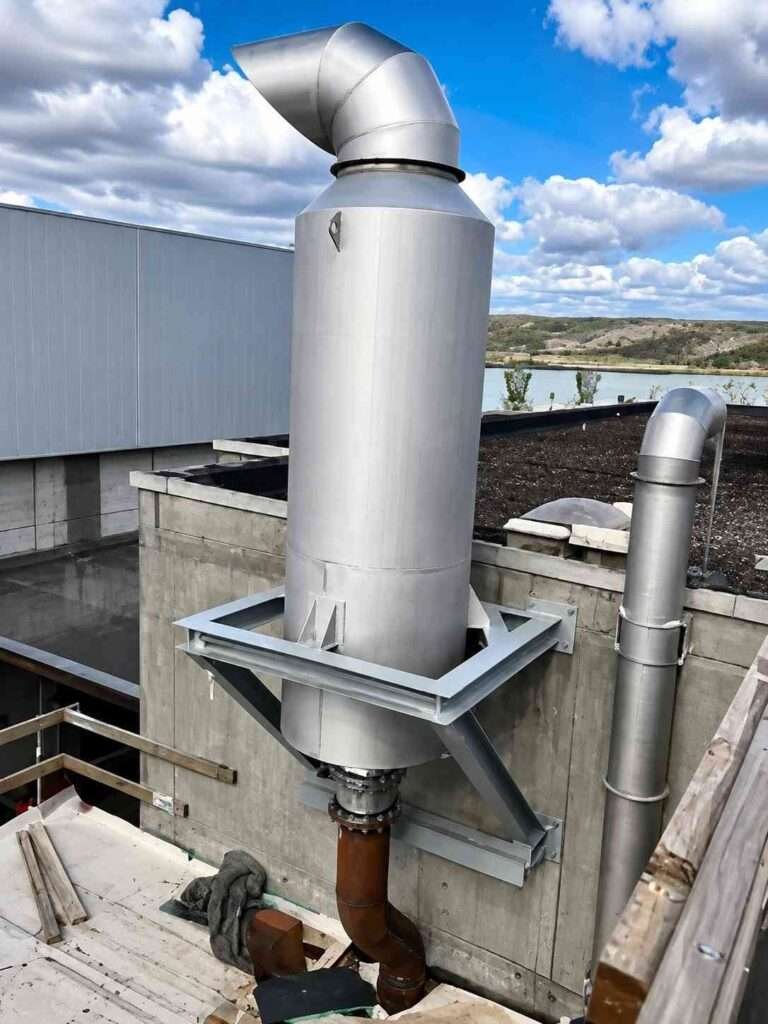
Industrial boilers, power plants, process steam systems, and utility facilities often release steam. They do this during startup, commissioning, warm-up, or low-load operation. Because this steam can discharge at high pressure and velocity, it can produce extremely high noise.
A properly engineered start up vent silencer helps reduce this noise before the steam is released into the atmosphere. Unlike a conventional muffler, a steam vent silencer must handle high-temperature steam, pressure fluctuations, high mass flow, and rapid changes in operating conditions while maintaining acceptable pressure drop and mechanical integrity.
Anpam Engineering manufactures customized start up vent silencers for boiler and industrial steam applications. We can engineer our solutions around steam pressure, temperature, mass flow, pipe size, required noise attenuation, allowable pressure drop, installation arrangement, and project specifications.
For power plants and process industries, the objective is not simply to make the steam discharge quieter. The silencer must provide effective acoustic attenuation while allowing the venting system to perform reliably during startup and other operating events.
Start Up Vent Silencer Manufacturer in India
As a startup vent silencer manufacturer in India, Anpam Engineering makes steam noise-control equipment. It is designed for boilers, power-generation systems, process plants, and industrial steam networks.
Operators commonly use a startup vent system when they bring a boiler or steam system online. During this period, steam conditions can change rapidly as pressure and temperature increase. You may need to vent steam until the system reaches the required operating conditions.
Direct discharge of high-pressure steam to atmosphere can generate intense aerodynamic noise.
A suitable start–up vent silencer is installed in the vent line to reduce noise from the discharge. The silencer design can be based on important operating parameters such as:
- Steam pressure
- Steam temperature
- Steam mass flow
- Steam quality
- Vent pipe size
- Inlet pressure
- Atmospheric discharge pressure
- Required noise level
- Allowable pressure drop
- Operating duration
- Installation orientation
- Material requirements
- Support arrangement
Providing accurate operating data lets us design the silencer for real steam conditions. It avoids using a generic configuration.
What Is a Start Up Vent Silencer?
A startup vent silencer is an engineered steam noise-control device. It is installed in a boiler or steam-system vent line. It reduces noise when steam is discharged to the atmosphere during startup.
During boiler startup, steam may vent through a startup line until the boiler and steam system reach safe conditions.
The high-pressure steam expands as it moves toward atmospheric pressure. This rapid expansion generates intense aerodynamic noise and can produce high-velocity flow through the discharge system.
The vent silencer provides controlled expansion and acoustic attenuation before the steam reaches the atmosphere.
A simplified arrangement is:
Boiler / Steam System → Startup Vent Valve → Vent Pipe → Start Up Vent Silencer → Atmospheric Discharge
The exact arrangement depends on the plant design, steam conditions, valve arrangement, and installation requirements.
Boiler Startup Vent Silencer
A Boiler Startup Vent Silencer is specifically designed for steam released during boiler startup.
Boilers can experience significant changes in steam pressure, temperature, and flow during startup. The venting system therefore needs to accommodate changing operating conditions.
A boiler startup vent silencer may be used in:
- Thermal power plants
- Captive power plants
- Process steam plants
- Cogeneration plants
- Sugar plants
- Chemical plants
- Textile plants
- Food-processing facilities
- Paper mills
- Refineries
- Petrochemical plants
- Industrial manufacturing facilities
The silencer should be selected based on the boiler’s startup vent requirements rather than simply matching the pipe diameter.
Important design inputs include maximum steam flow, pressure, temperature, venting duration, valve characteristics, required acoustic performance, and allowable pressure loss.
Why Is a Startup Vent Silencer Required?
Steam venting can be deafening because of high speed and pressure differences between the steam source and the air.
Uncontrolled steam discharge may result in:
- Excessive noise
- Disturbance to nearby personnel
- Elevated occupational noise exposure
- Acoustic impact on surrounding areas
- Pressure and flow disturbances
- Uncomfortable working conditions
The purpose of a vent silencer is to control this noise at the source.
Source-oriented noise control works well because it treats sound energy before it spreads through the area.
For industrial facilities, noise control may be part of a broader engineering approach. It can include equipment layout, acoustic enclosures, barriers, and vibration control. Personal hearing protection may also be needed, when applicable.
How Does a Start Up Vent Silencer Work?
A startup vent silencer controls the noise generated when high-pressure steam expands and discharges into the atmosphere.
The internal design can incorporate multiple stages of pressure reduction and acoustic attenuation.
A simplified process is:
High-Pressure Steam → Controlled Expansion → Flow Distribution → Acoustic Attenuation → Atmospheric Discharge
The internal configuration depends on the steam conditions and required acoustic performance.
The design may incorporate components such as:
- Diffusers
- Perforated plates
- Expansion chambers
- Acoustic attenuation elements
- Flow-distribution devices
- Multi-stage pressure reduction sections
- Drainage arrangements
The objective is to reduce the velocity and acoustic intensity of the steam discharge while maintaining acceptable pressure loss.
Because startup steam conditions can be demanding, the internal components must handle high heat. They must also withstand high steam speed and thermal cycling.
Design Considerations for a Startup Vent Silencer
A startup vent silencer should be engineered specifically for the steam system.
Steam Pressure
The inlet steam pressure is one of the most important design parameters. Higher pressure differences can produce greater discharge velocities and acoustic energy.
Steam Temperature
High-temperature steam requires suitable materials and consideration of thermal expansion.
Mass Flow Rate
The maximum and normal startup flow rates determine the required flow area and influence the internal configuration.
Allowable Pressure Drop
The silencer must provide noise reduction without creating excessive resistance in the vent system.
Pipe Diameter
The inlet and outlet dimensions affect the silencer configuration and connection arrangement.
Noise Requirement
The target sound level should be defined at an appropriate measurement location.
Operating Conditions
Startup, warm-up, low-load, normal venting, and other operating scenarios may need to be considered.
Thermal Expansion
Repeated startup and shutdown cycles can cause significant thermal movement. The silencer and its connected ductwork should accommodate expected expansion.
Startup Vent Silencer vs. Conventional Vent Silencer
Although both systems control noise from fluid discharge, startup vent applications can be more demanding.
A conventional low-pressure vent may operate under relatively stable conditions. A boiler startup vent, however, can experience rapid changes in:
- Pressure
- Temperature
- Flow
- Steam velocity
- Operating duration
Therefore, a Boiler Startup Vent Silencer should be designed around the actual startup operating envelope.
The correct solution depends on the steam system, not simply the nominal pipe size.
Types of Startup Vent Silencers
Different steam systems may require different configurations.
Vertical Start Up Vent Silencer
You can install a vertical configuration that discharges steam upward through a vertical vent system.
This arrangement may be suitable where the plant layout and discharge location allow vertical installation.
Horizontal Start Up Vent Silencer
Horizontal configurations can be used where the steam vent system requires a horizontal discharge arrangement.
The structural supports and drainage provisions should be considered carefully.
Multi-Stage Startup Vent Silencer
High-pressure steam applications may require multiple stages of expansion and acoustic attenuation.
A multi-stage configuration can help manage the pressure and acoustic energy associated with high-pressure steam discharge.
Customized Startup Vent Silencer
A custom design can be made for a specific boiler pressure, temperature, and flow rate. It can also meet acoustic targets, pipe dimensions, and installation limits.
Start Up Vent Silencer Applications
Startup vent silencers are used in many industries where steam systems operate under high-pressure conditions.
Power Plants
Boiler startup and commissioning operations can involve significant steam venting. A suitable silencer helps control the associated noise.
Captive Power Plants
Industrial plants with captive boilers and steam turbines can use startup vent silencers as part of their steam systems.
Sugar Plants
Sugar mills often operate boilers and steam systems for both process heating and power generation.
Chemical Plants
Process steam may be used for heating, reaction, evaporation, and other operations.
Petrochemical Facilities
Steam systems in petrochemical plants may require engineered vent and noise-control equipment.
Textile Plants
Industrial boilers provide steam for dyeing, finishing, drying, and other processes.
Food and Beverage Plants
Steam is commonly used for process heating, sterilization, cleaning, and utilities.
Paper and Pulp Plants
Paper manufacturing processes use large steam systems throughout.
Materials Used for Startup Vent Silencers
Material selection depends on operating temperature, pressure, steam quality, corrosion conditions, and project specifications.
Possible materials include:
- Carbon steel
- Stainless steel 304
- Stainless steel 316
- Alloy steel
- High-temperature materials
- Application-specific grades
High-temperature steam service requires particular attention to material strength, thermal expansion, welding, and internal component durability.
The external shell, internal components, connection flanges, drains, and support components may require different material specifications depending on the design.
Therefore, finalize material selection after you review the process conditions and applicable engineering requirements.
Importance of Pressure Drop
Pressure drop is a critical consideration when selecting a start up vent silencer.
A silencer that creates excessive resistance can affect the venting characteristics of the system.
The design should therefore balance:
Noise Attenuation + Flow Capacity + Pressure Drop + Mechanical Integrity
A properly sized silencer provides sufficient flow area and controlled internal geometry to achieve the required acoustic performance without unnecessarily restricting steam discharge.
Pressure-drop evaluation should consider the maximum steam flow rather than only normal operating conditions.
Acoustic Performance of a Vent Silencer
Steam noise is not simply measured by one overall sound-pressure value. The acoustic characteristics can vary across different frequencies.
A more detailed acoustic evaluation may consider:
- Sound pressure level
- Sound power level
- Frequency spectrum
- Octave-band levels
- Measurement distance
- Background noise
- Operating condition
- Required attenuation
This information helps engineers determine the appropriate acoustic configuration.
For a large industrial boiler, the required noise level may be set at the plant boundary. It may also be set at the operator location, the equipment area, or another specified measurement point.
Therefore, you should design the silencer to meet the actual project requirements.
Manufacturing and Quality Control
The performance of a startup vent silencer depends not only on its design but also on fabrication quality.
Anpam Engineering follows controlled manufacturing practices for industrial silencer fabrication.
Depending on project requirements, quality activities may include:
- Raw material inspection
- Material traceability
- Plate cutting and forming
- Precision fabrication
- Welding
- Dimensional inspection
- Weld inspection
- Non-destructive testing where specified
- Flange inspection
- Internal component inspection
- Final visual inspection
- Documentation
For high-temperature steam equipment, fabrication accuracy and internal component fit-up are particularly important because thermal cycling can impose additional mechanical stresses.
Why Choose Anpam Engineering?
Selecting the right start up vent silencer manufacturer in India requires consideration of both acoustic and process requirements.
Anpam Engineering provides customized industrial silencer solutions for steam, air, gas, exhaust, and other industrial applications.
Application-Specific Design
Our approach considers the actual steam pressure, temperature, flow rate, pipe size, noise target, and installation conditions.
Customized Construction
Startup vent silencers can be developed with customized dimensions, connections, supports, materials, and internal configurations.
Industrial Applications
Our silencers can be used across power generation, process industries, chemical plants, sugar plants, manufacturing facilities, and other industrial environments.
Focus on Noise and Flow
The objective is to achieve effective acoustic attenuation while maintaining the required venting characteristics.
Benefits of a Properly Engineered Start Up Vent Silencer
A suitable start up vent silencer can provide several operational benefits:
- Reduced steam discharge noise
- Improved acoustic conditions around boiler areas
- Better control of startup-related noise
- Reduced noise transmission to surrounding areas
- Suitable steam-flow capacity
- Controlled pressure drop
- High-temperature service capability
- Customized installation arrangements
- Long-term industrial service potential
Actual performance depends on steam conditions, silencer configuration, installation, operating conditions, and the specified acoustic measurement method.
Frequently Asked Questions
What is a start up vent silencer?
A start up vent silencer is a steam acoustic device installed in a boiler or steam-system startup vent line to reduce noise generated when steam is discharged to atmosphere.
What is a Boiler Startup Vent Silencer?
A Boiler Startup Vent Silencer is purpose-built to manage steam vented during boiler commissioning and startup. It is engineered based on steam pressure, temperature, flow rate, noise limits, and permissible pressure loss.
Why is a startup vent silencer required?
High-pressure steam discharge can generate intense aerodynamic noise. A startup vent silencer reduces this noise before the steam is released into the surrounding environment.
Can a startup vent silencer handle high-temperature steam?
Yes. The silencer can be designed for high-temperature steam service. It uses suitable materials and construction methods based on operating conditions.
How is a startup vent silencer selected?
Selection depends on steam pressure, temperature, and flow rate. It also depends on pipe size, noise limits, and allowable pressure drop. Consider the installation layout and operating conditions.
Can you customize the vent silencer?
Yes. Startup vent silencers can be customized according to steam conditions, dimensions, materials, acoustic targets, supports, and customer specifications.
Choose a Reliable Start Up Vent Silencer Manufacturer in India
Steam venting is essential during boiler startup and other industrial operations. But uncontrolled high-pressure steam discharge can cause significant noise.
A properly engineered start up vent silencer provides a practical way to control this noise while maintaining the required steam-flow characteristics.
Anpam Engineering makes custom Boiler Startup Vent Silencers for power plants and process industries. It also serves captive power facilities, sugar plants, chemical plants, and other steam applications.
Our engineering approach considers steam pressure, temperature, mass flow, acoustic requirements, allowable pressure drop, material selection, thermal expansion, and installation conditions.
If you are looking for a start up vent silencer manufacturer in India, share your boiler or steam-system details, vent pipe size, steam pressure, temperature, flow rate, and required noise level. The application can then be evaluated to determine an appropriate silencer configuration.