




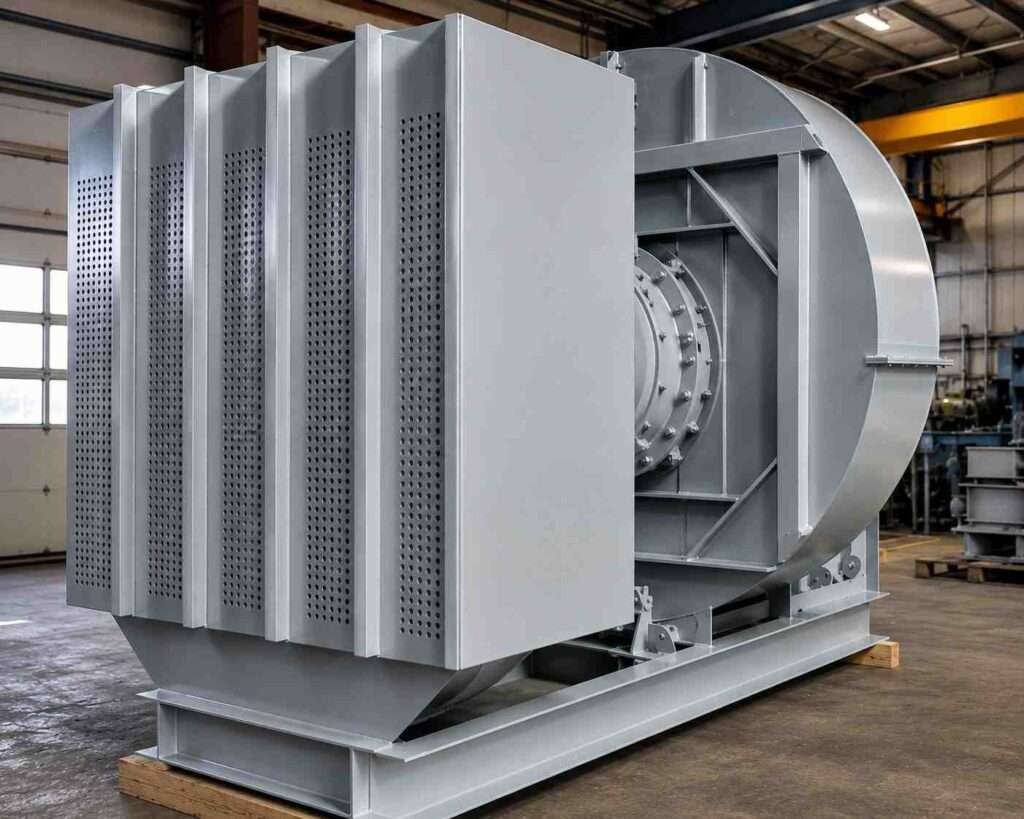
Industrial Fan Silencers for Reliable Noise Reduction
Industrial fans are essential in power plants, cement plants, steel plants, refineries, process industries, and manufacturing facilities. Equipment such as induced draft (ID) fans and forced draft (FD) fans handles large volumes of air and flue gas, often at high velocity. This airflow can generate considerable aerodynamic noise, while fan rotation, turbulence, pressure fluctuations, and connected ductwork can further contribute to the overall sound level.
A properly engineered Fan Silencer helps reduce noise while maintaining airflow and pressure needed for reliable fan operation. However, selecting a fan silencer is not simply a matter of matching the duct diameter. Evaluate fan capacity, air or gas flow, temperature, static pressure, velocity, allowable pressure drop, acoustic requirements, and installation conditions.
Anpam Engineering manufactures industrial fan silencers for ID fans, FD fans, centrifugal fans, ventilation systems, and process air systems. It also serves other high-capacity air-moving needs. We engineer our solutions according to equipment operating conditions and project requirements, with attention to acoustic performance, aerodynamic characteristics, mechanical integrity, and service life.
Fan Silencer Manufacturer in India
As an experienced Fan silencer manufacturer in India, Anpam Engineering provides customized noise-control solutions for industrial fans and air-handling systems.
Technicians usually install a fan silencer at a fan inlet, outlet, or duct connection. It reduces aerodynamic noise from airflow. In some installations, you may need acoustic treatment on both sides of the fan. The appropriate configuration depends on the characteristics of the equipment and the surrounding system.
Important design parameters include:
- Fan airflow
- Fan static pressure
- Operating temperature
- Gas or air density
- Inlet and outlet velocity
- Fan speed
- Duct dimensions
- Allowable pressure drop
- Required noise attenuation
- Installation location
- Available space
- Material requirements
Evaluating these parameters helps ensure that the silencer reduces noise without creating excessive resistance that could affect fan performance.
What Is a Fan Silencer?
A Fan Silencer is an acoustic device that reduces noise from industrial fans. It also reduces noise caused by air or gas flowing through fan systems.
Industrial fan noise can originate from several sources. Air moving around the blades and through the fan casing and ductwork produces aerodynamic noise. Mechanical noise can originate from bearings, motors, rotating components, and vibration. Flow disturbances can also generate pressure fluctuations and broadband noise.
A fan silencer primarily reduces noise that travels through the airflow path.
Depending on the application, a silencer can use:
- Acoustic absorption
- Expansion sections
- Perforated flow passages
- Flow-distribution elements
- Acoustic splitters
- Diffuser arrangements
- Combination attenuation stages
The internal configuration is selected according to the required acoustic performance and aerodynamic conditions.
The objective is to achieve effective industrial fan noise reduction while maintaining suitable airflow and minimizing pressure loss.
IDFD Fan Silencer for Industrial Fan Systems
Large industrial plants often rely on ID and FD fans within their combustion-air and flue-gas system setups.
An ID fan pulls flue gas through the boiler and gas-cleaning equipment. An FD fan pushes combustion air into the furnace or boiler system. Both applications involve high airflow and can generate significant aerodynamic noise.
Engineers can therefore design an IDFD fan silencer to control noise associated with these fan systems.
Depending on the plant arrangement, silencers may be installed at:
- ID fan suction
- ID fan discharge
- FD fan suction
- FD fan discharge
- Fan inlet ducts
- Fan outlet ducts
- Combustion-air systems
- Flue-gas systems
The final configuration depends on the source of the dominant noise and the acoustic requirements of the plant.
ID Fan Silencer
An induced draft fan operates on the flue-gas side of a boiler or industrial process. Because the fan handles hot gases, the silencer must handle heat. Because the fan may move large amounts of flue gas, the silencer must also reduce noise effectively.
An ID fan silencer may be used to control noise generated by:
- Fan aerodynamic operation
- High-velocity flue gas
- Turbulence
- Duct transitions
- Pressure fluctuations
- Fan rotation
The design should consider flue-gas temperature, flow rate, composition, and dust loading when needed. It should also consider static pressure and the allowed pressure drop.
For high-temperature applications, suitable materials and internal construction are particularly important.
FD Fan Silencer
A forced draft fan supplies combustion air to boilers, furnaces, and other combustion systems.
You can install an FD fan silencer on the suction or discharge side to reduce airflow-generated noise.
Typical applications include:
- Boiler combustion-air systems
- Industrial furnaces
- Thermal power plants
- Process heaters
- Waste-heat systems
- Industrial combustion systems
For FD fan uses, check pressure loss with care. Too much air-side resistance can affect fan operation and system efficiency.
How Does a Fan Silencer Work?
The operating principle of a fan silencer depends on its design configuration.
When air or gas flows through the silencer, its internal design reduces sound energy traveling through the flow path.
In an absorptive configuration, acoustic materials in the silencer absorb sound energy and release it as low-level heat. Other designs use expansion, diffusion, flow separation, or multiple attenuation stages to reduce noise.
A simplified flow arrangement can be represented as:
Fan → Duct → Silencer → Downstream System
or:
Air Intake → Silencer → Fan → Process System
The best location depends on where the main noise starts and how the fan connects to the whole process.
A well-designed silencer must balance:
Noise Attenuation + Airflow + Pressure Drop + Mechanical Strength + Maintenance Requirements
Types of Fan Silencers
Different fan applications require different configurations.
ID Fan Silencers
Designed for induced draft systems and flue-gas applications, with consideration of temperature, flow, pressure, and gas characteristics.
FD Fan Silencers
Used for forced draft systems and combustion-air applications.
Centrifugal Fan Silencers
Suitable for industrial centrifugal fans used in ventilation, process air, exhaust, and other applications.
Axial Fan Silencers
Designed for axial fan systems where large air volumes need to be moved with controlled acoustic emissions.
Fan Suction Silencers
Installed on the inlet side of a fan to reduce noise associated with intake airflow and fan operation.
Fan Discharge Silencers
Installed at the fan outlet to reduce aerodynamic noise generated by discharge airflow.
Customized Fan Silencers
Engineered for specific airflow, pressure, temperature, acoustic, material, and dimensional requirements.
Fan Silencer Applications
Fan silencers are used across many industries where high-capacity air-moving equipment creates excessive noise.
Power Plants
Power-generation facilities use ID and FD fans extensively in boiler and combustion systems. Properly engineered silencers can help control fan-related noise.
Cement Plants
Large fans are used for kiln systems, raw mills, clinker coolers, dust collection, and ventilation. These systems can generate substantial aerodynamic noise.
Steel Plants
Blast-furnace, combustion, ventilation, and process-air systems may require industrial fan noise-control solutions.
Refineries
Fans and air-handling equipment are used throughout refining processes and utility systems.
Petrochemical Plants
Process ventilation, combustion systems, and air-handling equipment can benefit from acoustic treatment.
Chemical Plants
Fans and blowers operating continuously in process areas may contribute significantly to overall plant noise.
Manufacturing Facilities
Industrial ventilation and exhaust systems can use fan silencers to improve workplace acoustic conditions.
Waste-to-Energy Plants
Combustion and flue-gas systems frequently use ID and FD fans, making fan noise control an important consideration.
Why Is Fan Silencer Design Important?
Engineers should create a fan silencer tailored specifically to the exact fan and system where it will run.
A poorly selected silencer can create excessive pressure drop, reducing the performance of the fan. Inadequate acoustic treatment, meanwhile, may fail to achieve the required noise reduction.
Proper design considers both acoustic and aerodynamic performance.
Noise Reduction
The silencer should be capable of achieving the required attenuation across the relevant frequency range.
Low Pressure Drop
The pressure loss through the silencer should remain within the allowable system limit.
Flow Uniformity
Internal geometry should avoid unnecessary turbulence or uneven flow distribution.
Temperature Resistance
High-temperature flue-gas applications require suitable materials and construction.
Mechanical Durability
The silencer must withstand vibration, thermal cycling, environmental conditions, and connected duct loads as applicable.
Key Factors for Selecting a Fan Silencer
Before selecting an industrial fan silencer, the following information should be evaluated.
Airflow or Gas Flow
The operating and maximum flow rates determine the required silencer flow area.
Static Pressure
Fan inlet and outlet pressures affect velocity, flow characteristics, and silencer design.
Temperature
Temperature influences gas density, acoustic behavior, thermal expansion, and material selection.
Fan Type
Centrifugal, axial, ID, and FD fans can have different acoustic and aerodynamic characteristics.
Noise Level
The existing noise level and target noise level should be established at defined measurement locations.
Frequency Spectrum
Fan noise is not necessarily uniform across frequencies. Acoustic attenuation should therefore consider the dominant frequency range.
Pressure Drop
The allowable pressure loss should be established before finalizing the silencer design.
Installation Conditions
Space, orientation, supports, duct configuration, access, and maintenance requirements should be considered.
Materials Used for Industrial Fan Silencers
Material selection depends on the operating conditions.
Common materials may include:
- Carbon Steel
- Stainless Steel 304
- Stainless Steel 316
- Alloy Steel
- High-Temperature Materials
- Application-Specific Material Grades
For standard ambient-air applications, carbon steel may be suitable. Consider stainless steel for corrosive environments or specific process requirements.
ID fan applications may involve elevated-temperature flue gas, requiring appropriate materials and consideration of thermal expansion.
Material selection should be based on:
- Design temperature
- Operating pressure
- Gas composition
- Corrosion potential
- Dust or particulate conditions
- Thermal cycling
- Environmental exposure
- Customer specifications
Manufacturing and Quality Control
Reliable fan silencer performance depends on both engineering design and fabrication quality.
Anpam Engineering follows controlled manufacturing practices for industrial silencer fabrication. Depending on project requirements, quality activities may include:
- Raw material verification
- Material traceability
- Plate forming and fabrication
- Precision welding
- Dimensional inspection
- Weld inspection
- Non-destructive testing where specified
- Internal component inspection
- Nozzle and flange verification
- Final visual inspection
- Documentation as required
Project-specific inspection and testing requirements can be incorporated into the manufacturing process.
Why Choose Anpam Engineering?
Selecting a capable Fan silencer manufacturer in India is important for applications where fans operate continuously under demanding conditions.
Application-Specific Engineering
Our designs are developed around actual airflow, pressure, temperature, acoustic requirements, and installation conditions.
Customized Solutions
Fan silencers can be customized for dimensions, materials, connections, supports, and internal configuration.
Industrial Applications
Our solutions work for ID fans, FD fans, centrifugal fans, axial fans, ventilation systems, and process air uses.
Focus on Flow and Acoustic Performance
The objective is not simply to reduce noise but to achieve noise attenuation without unnecessarily restricting the fan’s airflow.
Quality-Oriented Manufacturing
Controlled fabrication and inspection help support structural integrity and reliable operation.
Benefits of Installing a Properly Engineered Fan Silencer
A suitable Fan Silencer can provide several practical benefits:
- Reduced aerodynamic fan noise
- Improved workplace acoustic conditions
- Better control of industrial noise emissions
- Reduced noise transmission through ducts
- Suitable airflow performance
- Controlled pressure drop
- Improved integration with existing fan systems
- Long-term industrial service capability
The actual noise reduction depends on the fan characteristics, silencer design, installation arrangement, operating conditions, and surrounding acoustic environment.
Frequently Asked Questions
What is a fan silencer?
A fan silencer is an acoustic device installed in the airflow path of an industrial fan. It reduces aerodynamic noise and flow-generated noise.
What is an IDFD fan silencer?
An IDFD fan silencer is a noise-control solution intended for industrial ID and FD fan systems. The exact design depends on whether it is used on the induced-draft or forced-draft side. It also depends on the operating conditions.
What is the difference between an ID fan and FD fan?
An ID fan generally draws flue gas through a boiler or process system, while an FD fan supplies combustion air. Their operating temperatures, flow characteristics, and system requirements can therefore differ.
Can you install a fan silencer on both the suction and discharge sides?
Yes. Based on the noise source and system setup, you may add acoustic treatment at the fan inlet, outlet, or both.
Can you customize fan silencers?
Yes. Industrial fan silencers can be customized according to fan capacity, duct size, operating temperature, materials, acoustic requirements, pressure drop, and installation conditions.
Choose a Reliable Fan Silencer Manufacturer in India
Industrial fans are vital parts of many manufacturing and process systems. They move lrge volumes of air and gas. This can create significant aerodynamic noise. Controlling this noise requires an engineered solution that considers both acoustic performance and fan operating characteristics.
A properly designed Fan Silencer can reduce noise generated at fan suction or discharge locations while maintaining the airflow required by the process. For power plants and other large combustion systems, specialized IDFD fan silencer solutions can be developed for ID and FD fan applications.
Anpam Engineering manufactures customized fan silencers for power plants, cement plants, steel industries, chemical plants, refineries, petrochemical facilities, manufacturing units, and other industrial applications.
If you are looking for an experienced Fan silencer manufacturer in India, provide your fan type, airflow, pressure, temperature, duct size, operating conditions, and required noise level. Our engineering team can evaluate the application and recommend an appropriate acoustic solution.