




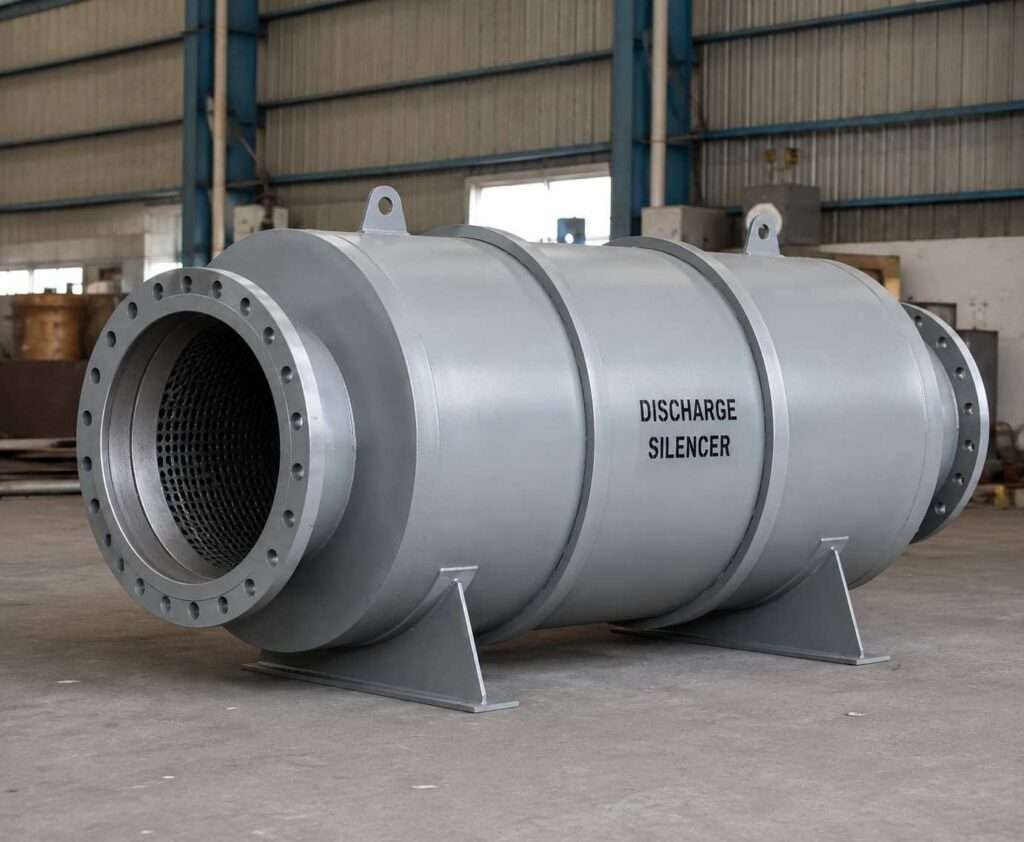
Reliable Discharge Silencer Solutions for Industrial Noise Control
Industrial equipment like blowers, compressors, fans, steam systems, and process gas equipment can create high noise at discharge outlets. High-velocity air, gas, or steam leaving the equipment creates aerodynamic turbulence, pressure fluctuations, and flow-generated sound. If you do not properly control this noise, it can affect workplace conditions, nearby machines, and the overall sound environment.
A well-engineered Discharge Silencer reduces outlet noise while keeping the flow capacity and efficiency the equipment needs. However, selecting the right silencer involves more than matching the discharge pipe size.
Flow rate, pressure, and temperature must be considered. Gas composition and equipment characteristics also matter. Allowable pressure drop and required noise reduction are important too.
Anpam Engineering manufactures customized industrial discharge silencers for applications involving air, gas, steam, blowers, compressors, fans, and process equipment. Our engineering approach focuses on achieving the required acoustic performance while maintaining suitable flow characteristics, mechanical strength, and long-term reliability.
Whether you need an air discharge silencer, fan discharge silencer, or steam discharge silencer, we can help. We also offer custom solutions for blowers and compressors. Our team develops equipment that meets your application requirements.
Discharge Silencer Manufacturer in India
As an experienced Discharge Silencer manufacturer in India, Anpam Engineering provides engineered noise-control solutions for demanding industrial environments.
A discharge silencer is usually installed at the outlet of equipment. It is used where high-velocity air, gas, or steam exits. The flow may enter a downstream pipe or the atmosphere. The silencer reduces the acoustic energy associated with the discharge while allowing the required process flow to continue.
Our design process considers important parameters such as:
- Flow rate
- Discharge pressure
- Operating temperature
- Gas or air properties
- Equipment capacity
- Outlet velocity
- Pipe diameter
- Allowable pressure drop
- Required noise attenuation
- Installation arrangement
- Material requirements
- Environmental conditions
This application-based approach helps ensure the silencer matches the equipment and process. Nominal pipe size alone does not determine it.
What Is a Discharge Silencer?
A Discharge Silencer is an acoustic device installed on the outlet side of industrial equipment. It reduces noise caused by high-velocity fluid flow.
When compressed air, gas, or steam exits an equipment outlet, it can convert pressure energy into kinetic energy. Rapid expansion, turbulence, and pressure fluctuations can create significant aerodynamic noise.
A discharge silencer manages this acoustic energy through an engineered internal flow path.
Depending on the application, the silencer may incorporate:
- Expansion chambers
- Diffuser sections
- Perforated flow elements
- Multi-stage pressure reduction
- Acoustic attenuation sections
- Flow distribution arrangements
- Absorptive components where suitable
The design objective is to achieve effective noise reduction without creating excessive pressure loss or negatively affecting the equipment’s operating performance.
Air Discharge Silencer for Industrial Applications
An air discharge silencer is used where compressed air or process air is discharged at high velocity.
Compressed air systems can produce significant outlet noise, particularly during venting, pressure release, pneumatic operations, or continuous discharge. A properly designed silencer helps reduce this noise at the source.
Air discharge silencers can be used with:
- Industrial blowers
- Air compressors
- Pneumatic systems
- Process air equipment
- Air receivers
- Ventilation systems
- Industrial fans
- Air pressure release systems
The silencer should be designed according to the actual airflow, pressure, temperature, and required acoustic performance.
For compressed-air applications, controlling pressure drop is especially important because unnecessary flow resistance can increase energy consumption or affect system capacity.
Discharge Silencer for Blower
Industrial blowers can be deafening at their discharge outlets. This noise comes from high airflow speed, pressure changes, and turbulent flow.
A well-engineered discharge silencer for blower applications helps cut outlet noise and still allows the required airflow.
Depending on the blower type, the design may be used with:
- Centrifugal blowers
- Roots blowers
- Positive displacement blowers
- Process blowers
- Industrial fans
- ID fans
- FD fans
For blower applications, the engineering team should check the blower’s flow rate and discharge pressure. They should also review operating temperature, speed, connection size, and system resistance.
The silencer should not become an unnecessary restriction in the blower discharge system.
Discharge Silencer for Compressor
Compressors can generate both mechanical and aerodynamic noise. The discharge piping can be an important path. Pressure pulsations and flow noise can travel through it into the surrounding area.
A discharge silencer for compressor use can cut outlet noise and reduce sound energy through the discharge system.
Depending on the compressor type, additional considerations may include:
- Pulsating flow
- Gas composition
- Discharge pressure
- Gas temperature
- Flow rate
- Compressor speed
- Pressure pulsation
- Allowable pressure drop
For reciprocating compressors, pulsation and acoustic interaction may require a different approach from rotary or centrifugal compressor applications. Therefore, consider compressor-specific operating data during silencer selection.
Fan Discharge Silencer for Industrial Noise Control
Industrial fans are widely used for ventilation, combustion air, cooling, exhaust, dust collection, and process applications. The discharge side can produce significant aerodynamic noise, particularly when it moves large volumes of air at high velocity.
A fan discharge silencer can be installed at the fan outlet. It can also be integrated into the discharge ductwork. It helps reduce noise caused by airflow.
Fan discharge silencers are commonly considered for:
- Centrifugal fans
- Axial fans
- ID fans
- FD fans
- Exhaust fans
- Process ventilation systems
- Industrial air-handling equipment
The silencer design must maintain sufficient airflow while minimizing pressure losses that could affect fan performance.
Steam Discharge Silencer
Steam systems present a particularly challenging acoustic environment because steam can operate at high pressure and temperature.
A steam discharge silencer reduces the noise that high-pressure systems generate when they discharge steam.
Applications can include:
- Steam venting
- Boiler systems
- Steam pressure reduction
- Startup operations
- Steam blowing
- Blowdown systems
- Power plant steam systems
- Process steam systems
Steam discharge silencer design requires careful consideration of:
- Steam pressure
- Steam temperature
- Mass flow rate
- Steam quality
- Discharge conditions
- Noise target
- Allowable pressure drop
- Thermal expansion
- Material selection
Because of the demanding thermal conditions, mechanical integrity and thermal stress considerations are important parts of the design process.
How Does a Discharge Silencer Work?
The working principle depends on the type and configuration of the silencer.
In a typical industrial discharge silencer, high-velocity air, gas, or steam enters through the inlet connection. The internal flow path then manages expansion, velocity distribution, and acoustic energy.
The flow may pass through multiple stages involving:
Equipment → Discharge Pipe → Silencer Inlet → Expansion/Diffusion → Acoustic Attenuation → Outlet
Controlled expansion reduces the intensity of pressure fluctuations, while internal acoustic elements attenuate the sound generated by the flow.
Engineers must design the silencer carefully because excessive internal resistance can cause undesirable pressure loss.
Therefore, successful silencer design requires a balance between:
Noise Reduction + Flow Capacity + Pressure Drop + Mechanical Strength + Service Life
Why Proper Discharge Silencer Design Matters
A poorly selected silencer may reduce noise but create excessive pressure loss. Conversely, a silencer with inadequate acoustic treatment may have minimal impact on the actual noise problem.
Proper engineering provides several benefits.
Effective Noise Attenuation
The silencer can be designed around the required sound reduction target.
Controlled Pressure Drop
Internal geometry can be optimized to minimize unnecessary resistance.
Reliable Flow
The silencer allows the required volume or mass flow to pass through the system.
Equipment Protection
Suitable design helps prevent excessive back pressure from affecting the connected equipment.
Long Service Life
Appropriate materials and construction improve durability under industrial operating conditions.
Types of Discharge Silencers We Manufacture
Air Discharge Silencers
Designed for compressed air and industrial air systems.
Blower Discharge Silencers
Engineered for centrifugal, Roots, and process blowers.
Compressor Discharge Silencers
Designed for compressor outlet applications involving air or process gases.
Fan Discharge Silencers
Suitable for industrial ventilation and fan systems.
Steam Discharge Silencers
Designed for high-temperature steam discharge and venting applications.
Gas Discharge Silencers
Used for process gases, natural gas, and other industrial gas systems.
Customized Discharge Silencers
Developed according to specific flow, pressure, temperature, acoustic, material, and installation requirements.
Industries We Serve
Our discharge silencers can be used across multiple industrial sectors.
Power Plants
Fans, compressors, boilers, steam systems, and auxiliary equipment can generate significant discharge noise. Engineered silencers help control these sources.
Oil & Gas
Refineries, gas processing facilities, compressor stations, and pipeline systems may require specialized gas and compressor discharge silencers.
Chemical Industries
Process equipment handling air and gases can benefit from application-specific acoustic solutions.
Petrochemical Plants
High-pressure process systems frequently require controlled discharge and noise attenuation.
Cement Plants
Large blowers, fans, and pneumatic conveying systems can generate substantial aerodynamic noise.
Steel and Heavy Industries
Industrial air systems, combustion equipment, and large fans may require discharge noise control.
Manufacturing Plants
Compressors, blowers, ventilation systems, and process equipment can use discharge silencers to improve the plant acoustic environment.
Materials Used for Discharge Silencers
Material selection depends on the operating environment and process conditions.
Common materials include:
- Carbon Steel
- Stainless Steel 304
- Stainless Steel 316
- Alloy Steel
- High-Temperature Materials
- Special Material Grades
For conventional air applications, carbon steel may be suitable. Select stainless steel where corrosion resistance or process compatibility matters.
High-temperature steam and process gas applications may require specialized materials for the shell and internal components.
Material selection should consider:
- Operating temperature
- Pressure
- Fluid composition
- Corrosion potential
- Environmental conditions
- Thermal cycling
- Customer specifications
Discharge Silencer Design Considerations
Before selecting a Discharge Silencer, the following parameters should be established.
Flow Rate
Normal and maximum flow rates determine the required flow area and internal configuration.
Pressure
Inlet and outlet pressure influence flow velocity and acoustic generation.
Temperature
Temperature affects fluid density, material selection, thermal expansion, and equipment design.
Fluid Properties
Air, steam, natural gas, and process gases behave differently and require different design considerations.
Noise Target
The required sound level should be established at a defined measurement distance and operating condition.
Pressure Drop
The allowable pressure drop should be defined to prevent the silencer from negatively affecting equipment performance.
Installation Space
Silencer dimensions, orientation, support requirements, and connection configuration must match the available installation area.
Manufacturing and Quality Assurance
Industrial discharge silencers must be manufactured with consistent dimensional accuracy and reliable welding quality.
At Anpam Engineering, quality activities may include:
- Raw material inspection
- Material traceability
- Plate cutting and forming
- Precision welding
- Dimensional inspection
- Weld inspection
- Non-destructive testing where specified
- Internal component inspection
- Nozzle and flange verification
- Final visual inspection
- Documentation according to project requirements
The inspection plan can be tailored to the customer’s technical specifications and application requirements.
Why Choose Anpam Engineering?
Selecting the right discharge silencer manufacturer in India is important. This matters even more when the silencer is part of a critical industrial process system.
Engineering Expertise
We consider equipment operating conditions, flow characteristics, acoustic requirements, and mechanical design requirements.
Customized Solutions
Silencer dimensions, materials, connections, supports, and internal configurations can be customized.
Multiple Applications
Our offerings cover steam, air, gas, blowers, compressors, and fans.
Quality-Focused Manufacturing
Controlled fabrication and inspection procedures support reliable product quality.
Industrial Project Support
We work with customers to understand their process conditions and develop suitable noise-control solutions.
Benefits of Choosing a Properly Engineered Discharge Silencer
A professionally designed discharge silencer can provide:
- Reduced industrial noise
- Improved workplace acoustic conditions
- Controlled discharge noise
- Lower risk of excessive pressure loss
- Reliable equipment operation
- Improved process-system integration
- Suitable long-term durability
- Application-specific acoustic performance
The exact performance depends on the equipment, operating conditions, silencer design, and installation environment.
Frequently Asked Questions
What is a discharge silencer?
A discharge silencer is a sound-attenuating device. It is fitted on the discharge/outlet side of industrial machinery. It lowers noise generated by high-velocity air, gas, or steam flow.
Where is a discharge silencer for blower used?
It is used at the outlet of centrifugal blowers, Roots blowers, process blowers, and industrial fans. It helps control aerodynamic discharge noise.
Why is a discharge silencer used with compressors?
A compressor discharge silencer can reduce outlet noise and help control acoustic energy transmitted through the discharge piping. Consider the compressor type, gas properties, pressure, temperature, and pulsation characteristics during design.
What is a steam discharge silencer?
A steam discharge silencer reduces noise from high-pressure or high-temperature steam releases. It is used with boilers, steam systems, power plants, and process equipment.
Can you customize discharge silencers?
Yes. Discharge silencers can be customized according to flow rate, pressure, temperature, fluid properties, acoustic requirements, connection size, material, and installation conditions.
Choose a Reliable Discharge Silencer Manufacturer in India
Industrial discharge noise can originate from blowers, compressors, fans, steam systems, and process gas equipment. Controlling this noise effectively requires a silencer that is engineered around the actual operating conditions of the equipment.
Anpam Engineering manufactures customized industrial silencers for power plants, oil & gas facilities, chemical plants, petrochemical facilities, cement plants, manufacturing units, and other process industries.
If you are looking for an experienced Discharge silencer manufacturer in India, share your equipment type, flow rate, pressure, temperature, connection size, and required noise level with our engineering team. We can evaluate your application and develop a suitable discharge noise-control solution.