

 blog
blog
What is an air receiver?
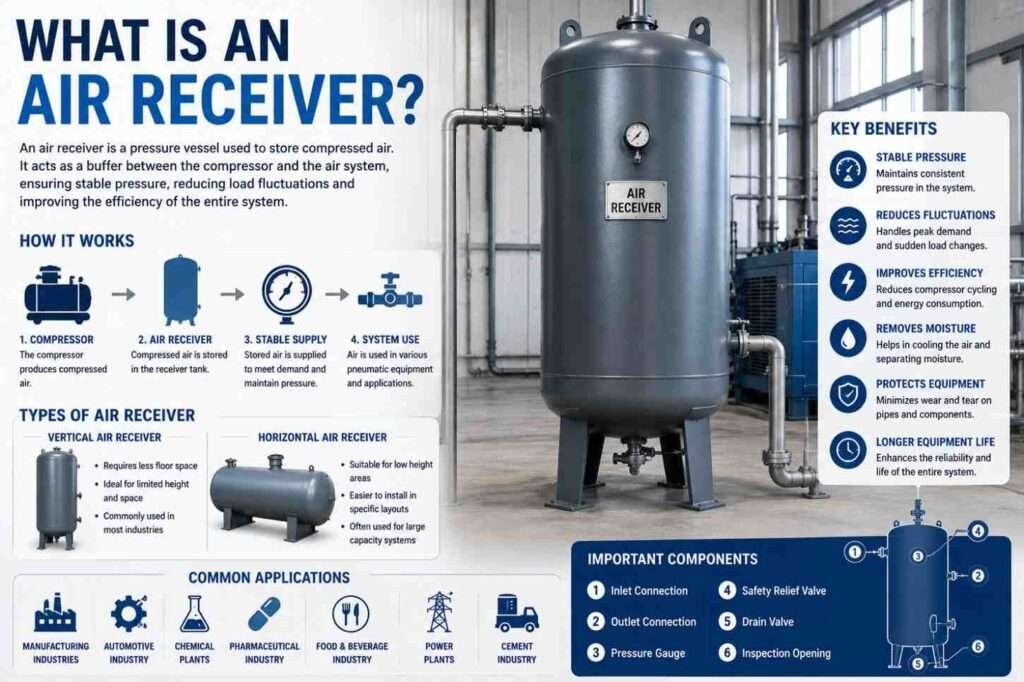
Compressed air is one of the most widely used utilities in modern industrial facilities. Manufacturing plants, workshops, process industries, power plants, pharmaceutical facilities, food processing units, and many other operations depend on compressed air for pneumatic tools, automation systems, instrumentation, cleaning, and process equipment.
However, producing compressed air is only one part of a reliable compressed-air system. To maintain stable pressure, handle changing demand, reduce compressor cycling, and improve overall system efficiency, an air receiver plays an important role.
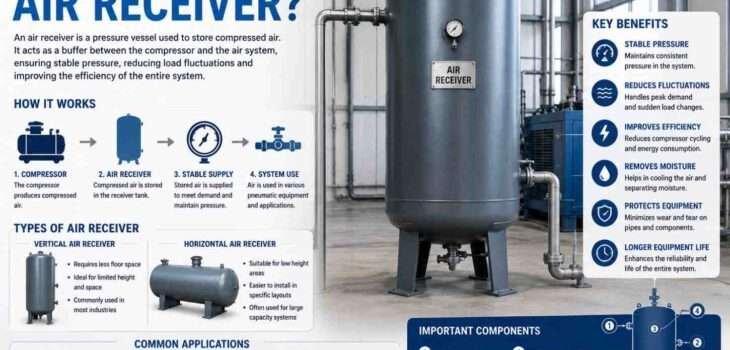
An air receiver, also called an air receiver tank or compressed air receiver, is a pressure vessel used to store compressed air and supply it to the system when required. It acts as a buffer between the compressor and the downstream equipment, helping the compressed-air system operate more smoothly.
For industrial buyers and engineers, understanding how an air receiver works is essential when selecting the correct capacity, pressure rating, material, and configuration.
What Is an Air Receiver?
An air receiver is a pressure vessel used to store compressed air.
The basic arrangement is straightforward:
Air Compressor → Air Receiver → Air Treatment → Distribution Network → Equipment
The compressor produces compressed air, while the receiver provides storage so that supply does not have to match demand every second.
Imagine a production line where several pneumatic tools operate intermittently. Air consumption may rise sharply when multiple tools start at the same time and then fall again a few seconds later. Instead of forcing the compressor to react instantly to every change, the receiver can supply part of that short-term demand from its stored volume.
Once demand falls, the compressor can replenish the stored air.
This simple buffering function can make a noticeable difference to system stability.
How Does an Air Receiver Work?
The principle is easier to understand through a typical operating cycle.
1. The compressor generates air
The compressor draws atmospheric air, compresses it, and sends it into the receiver.
2. Pressure builds inside the vessel
As compressed air enters, the pressure inside the tank rises until it reaches the control range of the system.
3. The receiver stores the compressed air
The stored air remains available for downstream equipment whenever additional flow is needed.
4. Demand increases
When production equipment consumes more air than the compressor is delivering at that moment, the receiver supplies part of the difference.
5. The compressor restores the stored volume
As the pressure falls, the compressor continues operating according to its control strategy and replenishes the air stored in the vessel.
This cycle allows compressed-air generation and consumption to be separated to some degree, which is one of the main reasons receivers are used in industrial systems.
Why Is an Air Receiver Important?
An air receiver does not generate compressed air, but it can make the entire system behave more predictably.
It Helps Stabilize Pressure
Pneumatic equipment often performs best within a reasonably stable pressure range. Large or sudden changes in demand can otherwise cause pressure fluctuations.
Stored air acts as a buffer, helping the downstream network maintain a more consistent supply.
It Helps Manage Short-Term Demand Peaks
Some machines have short bursts of high consumption. Designing the entire compressor system around the highest instantaneous demand can be expensive.
A suitably sized receiver can provide additional air during those brief peaks.
It Can Reduce Unnecessary Compressor Cycling
Depending on the compressor type and control system, additional storage can reduce frequent loading, unloading, or starting and stopping.
That can help reduce mechanical stress and improve operating stability.
The actual benefit depends on the compressor controls and the way the system is operated; a larger tank does not automatically guarantee lower energy consumption.
It Provides a Buffer During Transients
A sudden change in air demand does not always need an immediate change in compressor output. Stored air gives the system some time to respond.
This can be especially useful in facilities with intermittent pneumatic loads.
It Supports Condensate Management
As compressed air cools, moisture can condense. The relatively large volume of a receiver can provide an opportunity for some liquid water to collect at the vessel bottom.
A drain arrangement is therefore an important part of the design.
It is important to note that an air receiver is not a substitute for a proper air dryer, separator, or condensate-management system.
Main Parts of an Air Receiver
An air receiver may look like a simple steel tank, but several components are important to its safe operation.
Pressure Vessel Shell
The shell contains the compressed air and must be designed for the specified pressure and service conditions.
Its construction depends on the required capacity, pressure, material, temperature, corrosion environment, and applicable design requirements.
Inlet and Outlet Nozzles
The inlet allows compressed air to enter the vessel, while the outlet supplies air to the downstream system.
Nozzle size and arrangement should suit the intended flow and piping configuration.
Pressure Gauge
The gauge provides a direct indication of the vessel pressure and helps operators monitor normal operation.
Pressure Relief Valve
This is one of the most important safety devices on the vessel. The relief valve is intended to protect the receiver from excessive pressure.
It must be correctly selected, installed, inspected, and maintained.
Drain Arrangement
Moisture can accumulate at the bottom of the receiver. A manual or automatic drain allows this condensate to be removed.
Poor drainage can accelerate corrosion and reduce vessel life.
Inspection Opening
Depending on the size and design, the vessel may include a manway or other inspection opening to support internal examination and maintenance.
Types of Air Receivers
The best configuration depends on the available space and the way the compressed-air system operates.
Vertical Air Receiver
A vertical vessel stands upright and generally requires less floor area.
It is often a practical choice where:
- Floor space is limited
- Adequate ceiling height is available
- A compact footprint is preferred
Vertical receivers are common in compressor rooms and manufacturing facilities.
Horizontal Air Receiver
A horizontal vessel is installed parallel to the floor.
It can be useful where:
- Ceiling height is restricted
- The plant layout favors horizontal installation
- Large-capacity storage is required
The support arrangement and foundation need to be designed for the vessel and its operating loads.
Primary Receiver
A primary receiver is typically installed close to the compressor.
Its main role is to provide storage and help manage compressor operation.
Secondary Receiver
A smaller receiver may be installed closer to a machine or process with intermittent, high-volume demand.
This local storage can help reduce pressure disturbances without requiring the entire distribution system to be oversized.
Where Are Air Receivers Used?
Receivers are used in almost every industry that relies on compressed air.
Manufacturing Plants
Compressed air is used for pneumatic cylinders, automation, tools, actuators, packaging equipment, and production machinery.
Automotive Industry
Vehicle manufacturing and component plants use compressed air for assembly tools, automation, painting, handling systems, and other production activities.
Chemical Plants
Compressed air supports instrumentation, pneumatic controls, actuators, and various process functions.
Food and Beverage Facilities
Compressed air is used in packaging, bottling, conveying, automation, and production equipment. Where the air comes into direct contact with the product, the entire air-treatment system must be designed accordingly.
Pharmaceutical Manufacturing
Compressed air can be used for automation, instrumentation, packaging, and process support, with air quality requirements determined by the specific application.
Power Plants
Receivers support instrument air, control systems, pneumatic equipment, and maintenance operations.
Cement and Heavy Industry
Large industrial facilities may use compressed air for material handling, cleaning, control systems, pneumatic tools, and automated machinery.
How Do You Choose the Right Air Receiver?
There is no single air receiver size that works for every installation. Selection should be based on the way the compressed-air system actually operates.
1. Air Demand
Start with the real demand profile rather than relying only on compressor capacity.
Look at:
- Average consumption
- Peak consumption
- Intermittent demand
- Duration of peak demand
- Future expansion plans
Understanding when and how much air is consumed is often more useful than simply looking at the compressor nameplate.
2. Working Pressure
The receiver must be suitable for the maximum pressure at which the system is intended to operate.
The design pressure should be selected in accordance with the applicable engineering and statutory requirements.
3. Required Capacity
Receiver volume should be chosen based on system behavior, pressure control, compressor characteristics, and demand patterns.
A larger vessel is not automatically better. Oversizing adds cost and takes up additional space without necessarily solving the underlying problem.
4. Installation Arrangement
Choose between vertical and horizontal configurations based on:
- Available footprint
- Ceiling height
- Piping arrangement
- Access for inspection
- Maintenance space
- Foundation and support requirements
5. Material and Corrosion Conditions
Carbon steel is widely used in industrial applications, but the actual material selection should reflect operating conditions and corrosion risk.
Consider:
- Internal moisture
- External atmosphere
- Ambient humidity
- Chemical exposure
- Coating requirements
- Expected service life
6. Drainage and Water Management
Because moisture can collect inside the vessel, the drain arrangement deserves attention during design.
A good installation should make draining practical and reliable rather than treating it as an afterthought.
7. Applicable Standards and Regulations
An air receiver is a pressure vessel, so the design, fabrication, inspection, and certification requirements may be governed by applicable codes and local regulations.
The exact requirements depend on the jurisdiction, service, pressure, and project specifications.
Air Receiver Maintenance: What Should Be Checked?
A receiver can provide many years of service when it is properly maintained.
Drain Condensate
Moisture should be removed regularly. Automatic drains can simplify operation where suitable.
Inspect for Corrosion
Both external and internal surfaces should be checked for corrosion, coating failure, pitting, or other signs of deterioration.
Check the Relief Valve
The pressure relief device should be inspected and maintained according to the applicable maintenance program.
Monitor the Pressure Gauge
Operators should verify that the gauge is functioning correctly and that operating pressure remains within the permitted range.
Inspect Supports and Connections
Legs, saddles, foundations, nozzles, and connected piping should be checked for abnormal loads, damage, or movement.
Follow Required Inspections
Because the vessel stores compressed energy, inspection requirements should be based on the applicable legal and engineering framework rather than a generic maintenance interval.
Common Air Receiver Problems
Several issues can affect performance or shorten service life.
Internal Corrosion
Water accumulation is a common cause of internal corrosion. Effective drainage is therefore essential.
External Corrosion
Outdoor exposure, humidity, chemicals, and damaged coatings can cause external deterioration.
Blocked Drains
A drain that is not functioning can allow moisture to remain inside the vessel.
Incorrect Pressure Protection
The relief system must be appropriately selected and kept in serviceable condition.
Poor Installation
Inadequate supports, unsuitable foundations, or poorly arranged piping can place unnecessary loads on the receiver.
Undersized Storage
A receiver that is too small may provide insufficient buffering for a process with significant short-term demand changes.
Air Receiver vs Air Compressor
The two pieces of equipment work together but have very different jobs.
| Air Compressor | Air Receiver |
|---|---|
| Produces compressed air | Stores compressed air |
| Responds to system demand | Buffers supply and demand |
| Provides the primary source of air | Provides temporary stored capacity |
| Controls air generation | Helps stabilize system pressure |
A reliable compressed-air installation often needs both.
How an Air Receiver Can Improve System Performance
The value of a receiver is not limited to storage.
A properly integrated vessel can help a plant:
- Reduce short-term pressure fluctuations
- Handle intermittent demand
- Support smoother compressor operation
- Provide additional air during transient conditions
- Assist with condensate collection
- Improve overall system stability
However, a receiver should be viewed as one part of the system. If a plant has excessive leakage, poor pressure control, undersized piping, or inefficient compressor operation, adding a larger receiver alone may not solve the root cause.
This is an important consideration when evaluating compressed-air performance.
Safety First: Air Receivers Are Pressure Vessels
An air receiver stores significant amounts of compressed energy, so safe design and operation are essential.
A properly managed installation should include appropriate:
- Pressure relief protection
- Pressure indication
- Drainage
- Structural supports
- Inspection access
- Corrosion control
- Operating procedures
- Periodic inspections
The vessel should never be modified, drilled, welded, or otherwise altered without suitable engineering review and authorization.
Choosing an Air Receiver Manufacturer
When buying an air receiver for an industrial project, price is only one part of the decision.
Look for a air receiver manufacturer with experience in:
- Pressure-vessel engineering
- Material selection
- Fabrication and welding
- Inspection and quality control
- Documentation and traceability
- Application-specific design
- Statutory and project requirements
An experienced air receiver manufacturer in india should be able to review your operating pressure, required volume, layout, nozzle requirements, materials, and applicable standards before recommending a configuration.
Air Receiver Solutions from Anpam Engineering
Anpam Engineering manufactures engineered pressure vessels and air receiver tanks for industrial applications.
Receiver designs can be developed around project-specific requirements such as:
- Capacity
- Design and operating pressure
- Material specification
- Vertical or horizontal orientation
- Nozzle arrangement
- Drain configuration
- Support arrangement
- Inspection requirements
- Applicable codes and project specifications
The goal is to provide a vessel that fits the actual compressed-air system rather than offering a one-size-fits-all tank.
Frequently Asked Questions
What is an air receiver used for?
An air receiver stores compressed air and acts as a buffer between the compressor and the equipment using the air.
Does an air receiver improve pressure?
It can help stabilize pressure by supplying stored air when short-term demand increases. The overall system pressure still depends on compressor capacity, piping, controls, leakage, and demand.
Does an air receiver remove moisture?
Some condensate can collect inside the receiver as compressed air cools, but the vessel is not a replacement for a proper dryer and moisture-separation system.
Is a larger air receiver always better?
No. Receiver size should be based on system demand, compressor controls, pressure range, and the intended operating strategy. An oversized vessel can add unnecessary cost and space requirements.
What is the difference between a vertical and horizontal air receiver?
The main difference is installation orientation. Vertical vessels generally save floor space, while horizontal vessels can be useful where vertical clearance is limited.
How often should an air receiver be inspected?
Inspection frequency depends on local regulations, vessel design, operating conditions, and the applicable inspection program. A qualified inspection schedule should always be followed.
Conclusion
An air receiver may look like a simple tank, but it plays an important role in maintaining a stable and dependable compressed-air system.
By storing compressed air between periods of production and consumption, it can help manage short-term demand changes, reduce pressure fluctuations, support smoother compressor operation, and provide useful storage capacity for downstream equipment.
The right vessel, however, is not simply the one with the largest volume. Selection should consider demand patterns, working pressure, installation space, material compatibility, drainage, maintenance access, safety devices, and applicable pressure-vessel requirements.
For industrial applications, good engineering starts with understanding how the compressed-air system actually behaves. Once those requirements are clear, the receiver can be designed and selected to support safe, reliable, and efficient operation.