

 blog
blog
What is a Pressure Vessel? Types, Design and Applications
Pressure vessels are among the most critical pieces of equipment used in modern industries. From power plants and oil refineries to food processing facilities and pharmaceutical manufacturing units, these engineered containers safely store and transport gases or liquids under pressure. Without pressure vessels, many industrial processes that rely on controlled pressure and temperature would not be possible.
Because they operate under demanding conditions, engineers must design, manufacture, and test pressure vessels according to strict engineering standards. Factors such as internal pressure, operating temperature, corrosion resistance, material selection, and welding quality all influence their safety and performance. This is why industries rely on experienced manufacturers who follow internationally recognized standards such as ASME Section VIII and other applicable codes.
In this guide, you will learn what a pressure vessel is and how it works. You will also learn about the main types available and key design points. You will see which industries rely on pressure vessels. Whether you’re an engineer, plant manager, procurement professional, or someone exploring industrial equipment, this article provides a practical overview of pressure vessel technology.
What is a Pressure Vessel?
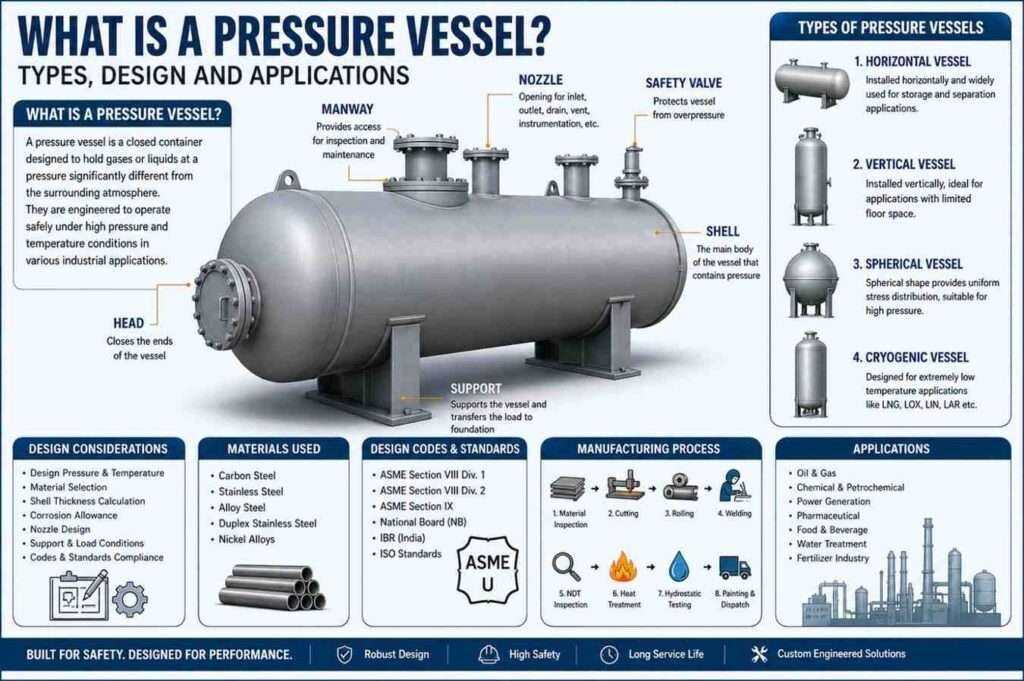
A pressure vessel is a special container. It holds gases, vapors, or liquids at a pressure different from the surrounding air. Unlike ordinary storage tanks, manufacturers build pressure vessels to withstand internal or external pressure safely. They also keep their structure strong during their operating life.
Pressure vessels are commonly used for:
- Storing compressed air and industrial gases
- Holding chemical fluids under pressure
- Heat transfer processes
- Steam generation and distribution
- Gas separation systems
- Process reactors
- Cryogenic storage
- Oil and gas processing
Since pressure vessels often run at high pressure and high temperatures, they use carefully selected materials. These include carbon steel, stainless steel, alloy steel, duplex stainless steel, and other special alloys. The choice depends on the operating environment, pressure rating, temperature, and the chemical properties of the process fluid.
Every pressure vessel is designed with safety as the highest priority. Engineering calculations determine the required shell thickness, head design, nozzle reinforcement, and support structure to ensure reliable operation under all specified conditions.
How Does a Pressure Vessel Work?
The working principle of a pressure vessel is straightforward but relies on advanced engineering. Engineers designed the vessel to contain fluids or gases while it resists the forces that internal pressure generates.
When you introduce a gas or liquid into the vessel, it exerts force on the internal walls. The vessel distributes this force evenly across its shell and heads, minimizing stress concentrations and maintaining stability. Proper material selection, wall thickness, and weld quality are essential to safely contain this pressure.
addition to pressure containment, many pressure vessels incorporate nozzles, manways, support structures, pressure relief valves, gauges, and instrumentation for monitoring and safe operation. Depending on the application, they may include internal parts like trays, baffles, coils, or agitators. These parts can improve process efficiency.
To ensure safe performance, pressure vessels undergo rigorous inspection and testing before commissioning. Typical quality checks include:
- Hydrostatic testing
- Radiographic Testing (RT)
- Ultrasonic Testing (UT)
- Dye Penetrant Testing (PT)
- Magnetic Particle Inspection (MPI)
- Dimensional inspection
- Pneumatic testing (where applicable)
These tests confirm the vessel meets design specifications and follows industry standards before it enters service.
Types of Pressure Vessels
Pressure vessels are available in various configurations to meet different industrial requirements. The selection depends on operating pressure, installation space, process conditions, and maintenance requirements.
1. Horizontal Pressure Vessels
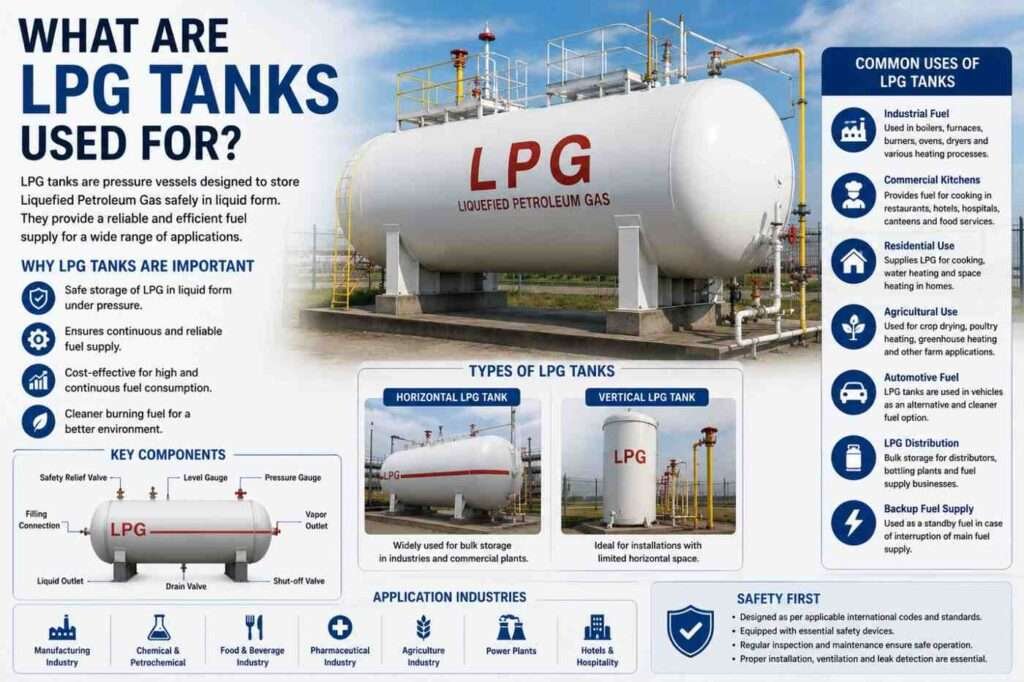
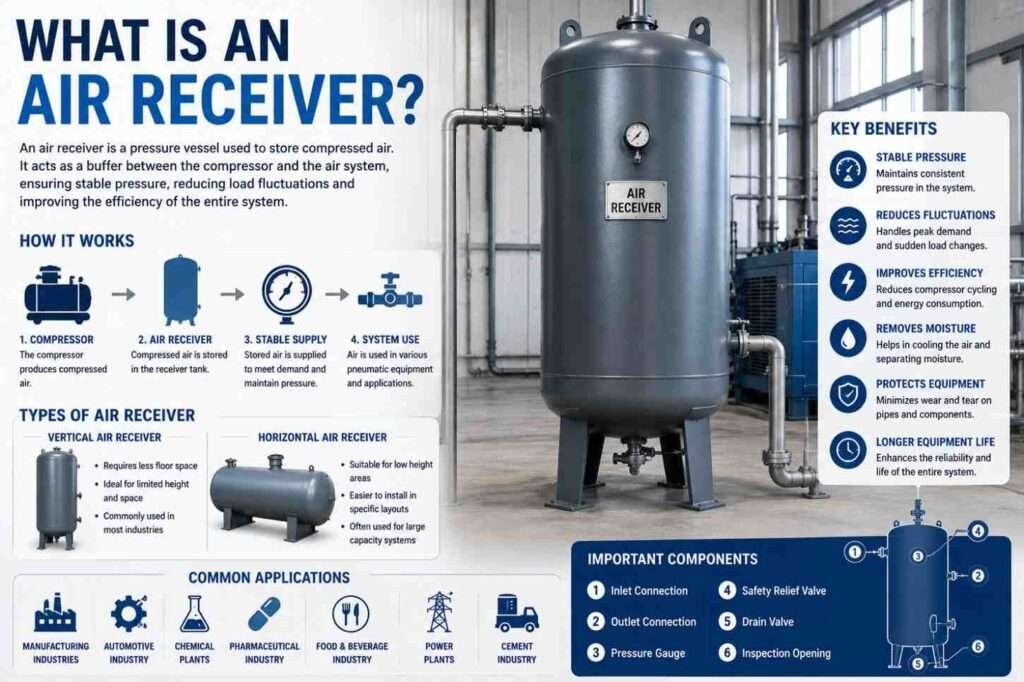
Horizontal pressure vessels are installed parallel to the ground and are widely used in industries requiring large storage capacities. Their design allows easier transport and maintenance. This makes them suitable for oil and gas facilities, chemical plants, and power projects.
Typical applications include:
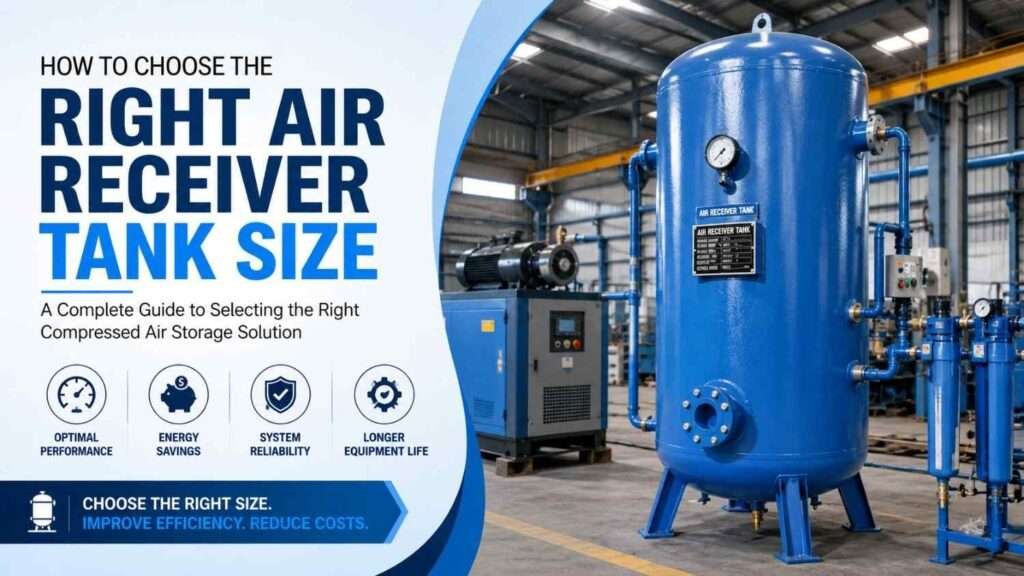
- Air receiver tanks
- LPG storage
- Process separators
- Fuel storage
- Surge vessels
2. Vertical Pressure Vessels
Vertical pressure vessels are mounted upright and are preferred when installation space is limited. Their compact footprint makes them common in chemical processing plants, pharmaceutical manufacturing facilities, and food processing industries.
They are frequently used for:
- Reactors
- Process columns
- Accumulators
- Water treatment systems
- Chemical storage
3. Cylindrical Pressure Vessels
The cylindrical shape is the most common pressure vessel design. It spreads internal pressure evenly. It also reduces stress points. Cylindrical vessels are efficient to manufacture and perform well under high-pressure operating conditions.
These vessels come in horizontal and vertical orientations and suit many industrial applications.
4. Spherical Pressure Vessels
Spherical pressure vessels provide the most uniform stress distribution under internal pressure. Their geometry minimizes stress concentrations, making them ideal for storing large volumes of high-pressure gases.
Although they offer superior mechanical performance, spherical vessels are more complex and expensive to manufacture. They are commonly used for:
- LPG storage terminals
- LNG facilities
- High-pressure gas storage
- Petrochemical installations
5. Cryogenic Pressure Vessels
Cryogenic pressure vessels are specially engineered to store liquefied gases at extremely low temperatures. They feature insulated, double-wall construction to minimize heat transfer and maintain the required cryogenic conditions.
Commonly stored products include:
- Liquid Nitrogen (LN₂)
- Liquid Oxygen (LOX)
- Liquid Argon (LAR)
- Liquid Carbon Dioxide (LCO₂)
- Liquefied Natural Gas (LNG)
Healthcare, industrial gas production, energy, aerospace, and scientific research widely use these vessels.
Pressure Vessel Design, Materials, Manufacturing Process & Standards
Pressure Vessel Design Considerations
Designing a pressure vessel involves much more than selecting a steel shell and welding it together. Every vessel must be built to handle its operating conditions during its service life. It must also maintain high safety and reliability.
Engineers start by understanding the process needs, including the fluid type, operating pressure, design pressure, and temperature. They also review corrosion allowance and expected service life. These factors determine the vessel’s dimensions, material selection, wall thickness, and structural supports.
A well-designed pressure vessel minimizes stress concentrations, allows efficient fabrication, and simplifies future inspection and maintenance. Advanced engineering software and finite element analysis (FEA) are often used for complex tasks. They help evaluate stress distribution and improve the design.
Key Design Parameters
When designing a pressure vessel, engineers evaluate several critical factors:
- Design pressure
- Design temperature
- Operating pressure
- Corrosion allowance
- Material strength
- Vessel diameter and length
- Shell thickness
- Head configuration
- Nozzle locations
- Support type
- Wind and seismic loads
- Fatigue loading
- Thermal expansion
- External pressure (if applicable)
Each parameter influences the overall safety, durability, and efficiency of the vessel.
Main Components of a Pressure Vessel
A pressure vessel consists of several engineered components working together to safely contain pressure.
Shell
The shell forms the main cylindrical body of the vessel and carries most of the internal pressure load. Qualified welders join rolled steel plates to manufacture it.
Heads
Heads are fitted to both ends of the shell and help distribute pressure evenly. Common head types include:
- Elliptical Heads
- Torispherical Heads
- Hemispherical Heads
- Flat Heads (used for low-pressure applications)
The choice of head depends on pressure rating, fabrication cost, and design requirements.
Nozzles
Nozzles provide inlet and outlet connections for process fluids. Engineers also use them for instrumentation, pressure gauges, safety valves, drains, vents, and manways.
Proper reinforcement around nozzle openings is essential because these areas experience higher localized stresses.
Supports
Support structures depend on the vessel orientation.
Typical support categories include:
- Saddle-style Supports
- Skirt-type Supports
- Leg-style Supports
- Lug-type Supports
The support design must account for the vessel’s weight, wind loads, seismic conditions, and thermal expansion.
Materials Used in Pressure Vessel Manufacturing
Choosing the right material is among the most critical factors in pressure vessel engineering. The selected material must withstand pressure, temperature, corrosion, and process conditions while providing long service life.
Carbon Steel
Carbon steel is the most commonly used material because it offers excellent strength, weldability, and cost-effectiveness.
Typical applications include:
- Air receiver tanks
- Steam vessels
- Water storage
- Process vessels
Stainless Steel
Stainless steel provides outstanding corrosion resistance, making it ideal for hygienic and corrosive environments.
Industries include:
- Pharmaceutical
- Food processing
- Chemical plants
- Beverage manufacturing
Common grades:
- SS304
- SS304L
- SS316
- SS316L
Alloy Steel
Alloy steels are used where high temperatures and pressures are involved.
Applications include:
- Refineries
- Power plants
- Petrochemical industries
Duplex & Super Duplex Stainless Steel
These materials provide exceptional resistance to:
- Chloride corrosion
- Pitting
- Stress corrosion cracking
They are widely used in offshore and marine environments.
Nickel Alloys
Nickel-based alloys are selected for extremely corrosive and high-temperature applications where conventional steels cannot perform reliably.
Pressure Vessel Manufacturing Process
Manufacturing a pressure vessel requires precision, skilled workmanship, and strict quality control. We document every stage to ensure compliance with customer specifications and international standards.
1. Engineering & Design
The process begins with detailed engineering calculations and fabrication drawings. Engineers determine the vessel dimensions, shell thickness, nozzle locations, support arrangements, and material specifications based on project requirements.
2. Material Procurement
Raw materials are sourced from approved suppliers and verified through Mill Test Certificates (MTCs). Inspect each plate, pipe, forging, and fitting to ensure compliance with the specified material grade.
3. Plate Cutting
Steel plates are cut to the required dimensions using CNC plasma, laser, or oxy-fuel cutting machines. Precision cutting minimizes material waste and ensures accurate fabrication.
4. Plate Rolling
The cut plates are rolled into cylindrical shells using heavy-duty plate rolling machines. Proper rolling ensures dimensional accuracy and a uniform cylindrical shape.
5. Welding
Welding is among the most vital steps in the fabrication of pressure vessels. Certified welders follow approved Welding Procedure Specifications (WPS) and Procedure Qualification Records (PQR) to produce strong, defect-free welds.
Common welding processes include:
- GTAW (TIG)
- GMAW (MIG)
- SAW (Submerged Arc Welding)
- SMAW (Shielded Metal Arc Welding)
Each weld is inspected according to the project specifications before proceeding to the next stage.
6. Heat Treatment (If Required)
Depending on the material and thickness, Post Weld Heat Treatment (PWHT) may be used. It helps relieve residual stress and improve the welded joint’s mechanical properties.
Codes commonly require PWHT for heavy-wall pressure vessels and high-temperature service.
7. Machining
Critical parts, like flanges, nozzle faces, and manway openings, are machined for exact sizes and good seals.
Quality Assurance & Inspection
Quality assurance is integrated throughout the manufacturing process. Every pressure vessel undergoes multiple inspections to verify compliance with design codes and customer requirements.
Typical inspections include:
- Visual Inspection (VT)
- Radiographic Testing (RT)
- Ultrasonic Testing (UT)
- Magnetic Particle Testing (MT)
- Dye Penetrant Testing (PT)
- Positive Material Identification (PMI)
- Dimensional Inspection
- Weld Inspection
These inspections help us identify defects before we place the vessel into service.
Hydrostatic Testing
Before delivery, every pressure vessel is subjected to hydrostatic testing. During this test, the vessel is filled with water. It is then pressurized above its rated design pressure. This checks structural strength and leak-tight performance.
Hydrostatic testing is an important acceptance test. It shows the vessel can safely withstand the required operating conditions.
When an application cannot use water, technicians may perform pneumatic testing under carefully controlled conditions.
Pressure Vessel Design Codes & Standards
Pressure vessels are designed and manufactured according to internationally recognized engineering codes that ensure consistent safety and performance.
Some of the most widely used standards include:
ASME Section VIII Division 1
The most commonly adopted code for designing and constructing pressure vessels used in industrial applications. It provides rules for material selection, design calculations, fabrication, inspection, testing, and certification.
ASME Section VIII Division 2
Used for more demanding applications requiring advanced design methods, detailed stress assessment, and optimized construction for higher pressures or complex operating conditions.
ASME Section IX
Covers the qualification requirements for welding procedures (WPS), Procedure Qualification Records (PQR), and welder performance qualifications, ensuring weld quality and reliability.
National Board (NB) Registration
Many pressure vessels intended for regulated markets are registered with the National Board, providing traceability and demonstrating compliance with applicable code requirements.
IBR Requirements
For steam equipment in India, pressure vessels may also need to meet the Indian Boiler Regulations (IBR). This depends on the application.
Following these standards helps make sure pressure vessels are built safely. It also helps ensure high quality. It supports long-term reliability.
Applications, Benefits, Maintenance, FAQs & Conclusion
Industrial Applications of Pressure Vessels
Pressure vessels are vital in many industries. They safely store, process, and transport pressurized fluids and gases. Their versatility allows them to support critical manufacturing operations while improving efficiency, reliability, and safety.
Oil & Gas Industry
The oil and gas sector relies heavily on pressure vessels for upstream, midstream, and downstream operations. They are used as separators, surge drums, knockout drums, scrubbers, filter vessels, and storage systems. They handle hydrocarbons under high pressure.
Common applications include:
- Oil and gas separation
- Natural gas processing
- LNG facilities
- Offshore platforms
- Refineries
- Compressor stations
Chemical & Petrochemical Industry
Chemical processing plants use pressure vessels to safely handle corrosive chemicals, solvents, acids, and process gases. Many of these applications involve elevated temperatures and aggressive operating environments, requiring specialized materials and precision engineering.
Typical equipment includes:
- Chemical reactors
- Mixing vessels
- Storage vessels
- Process columns
- Pressure filters
Power Generation
Power plants depend on pressure vessels for steam generation, condensate systems, feedwater storage, and heat recovery. Engineers design these vessels to withstand continuous high-temperature and high-pressure operation.
Applications include:
- Boiler drums
- Deaerators
- Feedwater heaters
- Condensate tanks
- Steam separators
Pharmaceutical Industry
In pharmaceutical manufacturing, pressure vessels support sterile and hygienic production processes. Stainless steel vessels are preferred because they resist corrosion well. They can also be cleaned easily to meet strict quality standards.
Typical uses include:
- Sterile reactors
- Mixing vessels
- Process tanks
- Fermentation systems
Food & Beverage Industry
Pressure vessels play an important role in food processing by supporting pasteurization, sterilization, brewing, dairy processing, and beverage production. Hygienic design and food-grade materials help maintain product quality and safety.
Water Treatment Plants
Water treatment facilities use pressure vessels in filtration systems, reverse osmosis (RO) plants, and demineralization units to improve water quality and process efficiency.
Fertilizer & Process Industries
High-pressure chemical reactions are common in fertilizer production. Pressure vessels safely contain ammonia, urea, and other process chemicals while maintaining stable operating conditions.
Benefits of High-Quality Pressure Vessels
Investing in a well-designed pressure vessel provides long-term operational and financial advantages.
Enhanced Safety
Pressure vessels manufactured according to recognized engineering standards significantly reduce the risk of leaks, structural failures, and operational hazards.
Improved Process Efficiency
A properly designed vessel maintains stable pressure and temperature, leading to consistent process performance and higher productivity.
Longer Service Life
High-quality materials, certified welding procedures, and protective coatings improve durability and minimize wear, corrosion, and fatigue over time.
Lower Maintenance Costs
Reliable fabrication and quality assurance reduce unexpected downtime and maintenance expenses throughout the equipment’s lifecycle.
Regulatory Compliance
Pressure vessels designed to standards such as ASME Section VIII help organizations meet regulatory and customer requirements, supporting safe and compliant operations.
Custom Engineering
Manufacturers can tailor pressure vessels to meet specific process conditions, available installation space, and industry requirements, ensuring optimal performance for each application.
Pressure Vessel Maintenance Best Practices
Even the best-designed pressure vessel requires routine maintenance to ensure continued safety and efficiency. A structured maintenance program helps identify potential issues before they develop into costly failures.
Recommended practices include:
- Perform regular visual inspections.
- Monitor operating pressure and temperature.
- Inspect safety valves periodically.
- Check for corrosion and erosion.
- Examine weld joints for signs of cracking.
- Verify nozzle and flange integrity.
- Calibrate pressure gauges and instrumentation.
- Conduct scheduled non-destructive testing (NDT).
- Maintain inspection and maintenance records.
- Follow applicable inspection intervals based on service conditions and regulatory requirements.
Preventive maintenance not only extends equipment life but also minimizes unplanned shutdowns and improves overall plant reliability.
Common Challenges in Pressure Vessel Operation
Despite their strong build, pressure vessels can have issues if not well maintained. They can also fail if used beyond design limits.
Some common challenges include:
- Internal and external corrosion
- Fatigue because of cyclic pressure loading
- Stress corrosion cracking
- Erosion caused by abrasive fluids
- Overpressure events
- Poor welding quality
- Material degradation at elevated temperatures
- Inadequate inspection or maintenance
Addressing these challenges through proper design, material selection, and periodic inspection helps ensure safe, long-term performance.
Choosing the Right Pressure Vessel Manufacturer
Selecting the right pressure vessel manufacturer in India is just as important as choosing the right equipment. Consider the following factors when evaluating potential manufacturers:
- Experience in pressure vessel design and fabrication
- Compliance with ASME and other applicable standards
- Qualified engineering and welding teams
- Advanced manufacturing facilities
- Comprehensive quality control procedures
- Capability for custom-engineered solutions
- Third-party inspection support
- On-time delivery and after-sales assistance
A trusted manufacturer should be able to provide complete documentation, including material certificates, welding qualifications, inspection reports, and test records.
Frequently Asked Questions (FAQs)
1. What is the main function of a pressure vessel?
Engineers design a pressure vessel to safely contain gases or liquids at pressures significantly different from atmospheric pressure. Many industrial applications use it for storage, processing, and heat transfer.
2. What materials are commonly used to manufacture pressure vessels?
Common materials include carbon steel, stainless steel, and alloy steel. They also include duplex and super duplex stainless steel. Nickel-based alloys are also common. The selection depends on pressure, temperature, and corrosion requirements.
3. What is the difference between a pressure vessel and a storage tank?
A pressure vessel is specifically designed to withstand internal or external pressure, while a standard storage tank generally operates at or near atmospheric pressure.
4. What is ASME Section VIII?
ASME Section VIII is an internationally recognized code that provides rules for the design, fabrication, inspection, testing, and certification of pressure vessels.
5. What tests do technicians perform before they deliver a pressure vessel?
Typical tests include hydrostatic testing and pressure testing. Other tests include radiographic inspection (RT) and ultrasonic inspection (UT). You may also use magnetic particle inspection (MT) and dye penetrant inspection (PT). Visual inspection and dimensional checks are common too. The project requirements determine which tests you need.
6. Which industries use pressure vessels?
Pressure vessels are used in oil and gas, petrochemical, chemical processing, pharmaceuticals, food and beverage, power generation, water treatment, mining, and many other industrial sectors.
7. Can pressure vessels be custom designed?
Yes. Pressure vessels can be engineered to meet specific operating pressures, temperatures, process requirements, material specifications, and dimensional constraints.
8. How often should a pressure vessel be inspected?
Inspection frequency depends on factors such as the service conditions, operating pressure, material, applicable regulations, and the facility’s maintenance program.
Conclusion
Pressure vessels are vital assets in today’s industrial environments, offering a secure and dependable solution for storing, handling, and moving fluids and gases under pressure. From power stations and refineries to pharma plants and food processing facilities, they are crucial for maintaining efficient output and safe operational performance.
Their performance depends on careful engineering, appropriate material selection, compliance with internationally recognized standards, and rigorous quality assurance throughout the manufacturing process. Equally important are routine inspections and preventive maintenance, which help extend service life and reduce operational risks.
Whether you require a standard vessel or a custom-engineered solution, partnering with an experienced manufacturer that follows recognized codes such as ASME Section VIII ensures your equipment is built for safety, durability, and long-term performance.