

 blog
blog
What are LPG tanks used for?
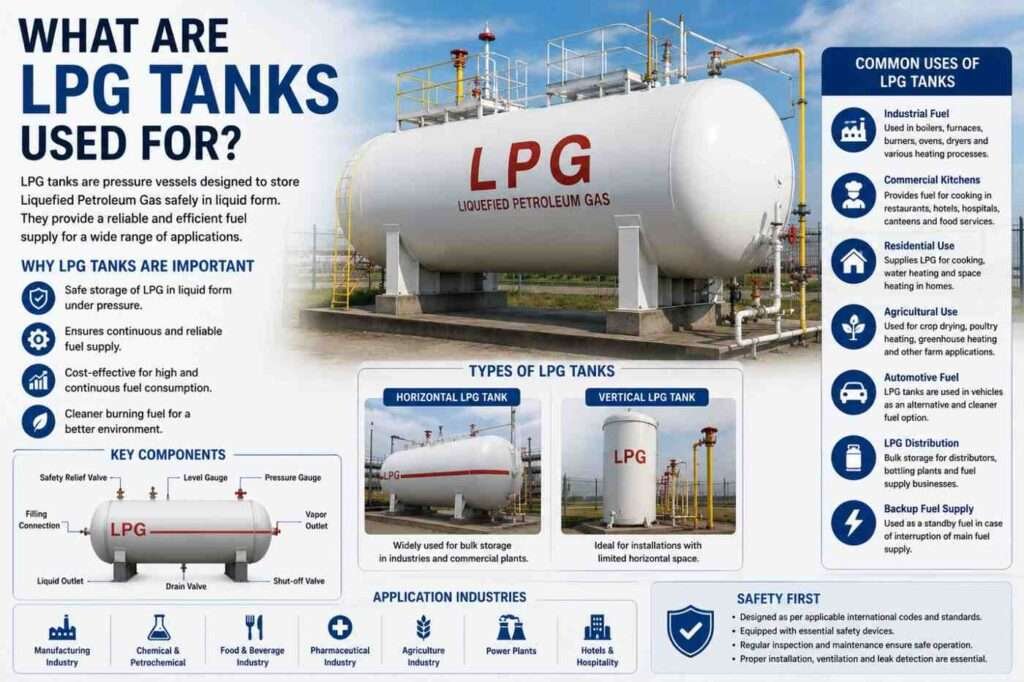
Liquefied Petroleum Gas (LPG) is widely used as a practical and efficient fuel for homes, commercial facilities, agriculture, transportation, and industrial processes. Because LPG is stored as a liquid under pressure and changes into a gas when released, it requires specially designed storage equipment. This is where an LPG tank plays an important role.
LPG tanks provide a controlled and secure way to store LPG before it is supplied to burners, boilers, process equipment, generators, vehicles, or other gas-consuming systems. They are available in different capacities and configurations depending on the application, location, operating conditions, and required storage volume.
For industrial users, choosing an LPG tank is not simply about selecting a vessel with a particular capacity. The tank must be appropriate for the LPG service, pressure, temperature, installation arrangement, safety requirements, and applicable regulations.
This guide explains what LPG tanks are used for, how they work, where they are installed, the different types available, and what to consider when selecting an LPG storage tank.
What Is an LPG Tank?
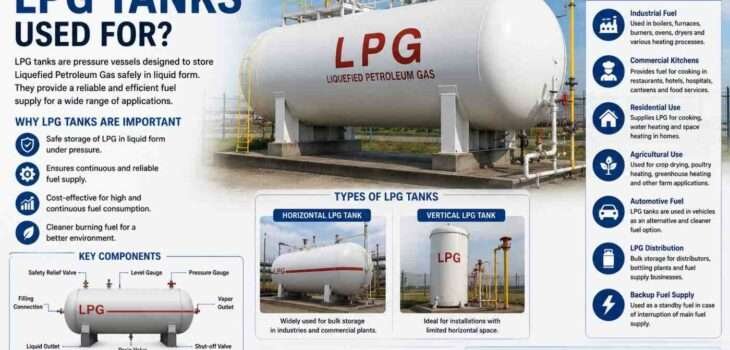
An LPG tank is a pressure vessel designed to store liquefied petroleum gas in liquid form under pressure.
LPG commonly contains hydrocarbons such as propane, butane, or mixtures of these gases. Under suitable pressure, the gas can be stored as a liquid, allowing a relatively large quantity of fuel to be contained in a manageable vessel.
Inside the tank, LPG exists primarily as a liquid with a vapor space above it. As LPG is withdrawn for use, some of the liquid evaporates to replace the gas removed from the vapor space.
This is why LPG tanks need to be designed specifically for pressurized hydrocarbon service rather than treated like ordinary atmospheric storage tanks.
What Are LPG Tanks Used For?
The main purpose of an LPG tank is to store LPG safely and make it available when needed.
However, their role varies significantly depending on the application.
1. Industrial Fuel Storage
One of the most common uses of LPG tanks is storing fuel for industrial processes.
Factories may use LPG for:
- Industrial burners
- Process heating
- Furnaces
- Ovens
- Boilers
- Dryers
- Heat-treatment equipment
- Metal-processing operations
An appropriately sized tank allows the facility to maintain a consistent fuel supply without relying entirely on frequent cylinder changes or immediate delivery.
For plants with high and continuous fuel demand, bulk LPG storage can be more practical than using individual cylinders.
2. Boiler Fuel Supply
LPG is used as a fuel for certain industrial and commercial boilers.
An LPG tank can store the required fuel and supply it to the boiler through a controlled gas distribution system.
This can be useful where:
- Natural gas is unavailable
- A cleaner-burning alternative to certain liquid fuels is preferred
- Reliable fuel storage is required
- The facility needs a dedicated LPG supply
Tank capacity should be selected based on boiler fuel consumption, expected operating hours, delivery frequency, and required reserve capacity.
3. Commercial Kitchens and Restaurants
Restaurants, hotels, catering facilities, and institutional kitchens can use LPG as a cooking fuel.
Small users may rely on cylinders, while larger commercial operations may use bulk LPG tanks connected to a central gas distribution system.
Bulk storage can simplify fuel management and reduce the need for frequent cylinder replacement.
Typical users include:
- Hotels
- Restaurants
- Industrial canteens
- Hospitals
- Educational institutions
- Catering facilities
The installation must be appropriately designed for the site and local safety requirements.
4. Residential LPG Storage
LPG tanks can also be used for residential applications, particularly where bulk LPG delivery is available and pipeline natural gas is not.
A tank may supply:
- Cooking appliances
- Water heaters
- Space heating systems
- Backup heating equipment
Residential LPG tanks are generally smaller than the large storage vessels used in industrial facilities, and their installation requirements are closely controlled because LPG is a flammable fuel.
5. LPG Distribution and Storage Facilities
LPG distributors and gas suppliers require larger storage vessels to receive, hold, and distribute LPG.
These installations can include:
- LPG storage terminals
- Bulk storage yards
- Gas distribution facilities
- Cylinder filling plants
- Bottling plants
Here, several vessels may be installed together to provide the required storage capacity.
The overall system can include pumps, compressors, transfer lines, valves, instrumentation, vapor management, and safety equipment.
6. Agricultural Applications
Agricultural operations use LPG in several applications where controlled heating or fuel supply is required.
Examples include:
- Crop drying
- Grain drying
- Poultry heating
- Greenhouse heating
- Food processing
- Agricultural machinery fuel systems
For seasonal applications, an appropriately sized LPG tank can help provide sufficient fuel during periods of high consumption.
7. LPG-Powered Vehicles
LPG is also used as an automotive fuel in vehicles equipped for LPG operation.
In this application, the storage vessel is designed specifically for vehicle installation and must meet the requirements applicable to automotive LPG systems.
These tanks differ from stationary bulk storage vessels in their design, size, installation, and safety requirements.
8. Backup and Standby Fuel Systems
Some facilities use LPG tanks as part of a backup fuel strategy.
For example, a facility may use LPG when:
- The primary fuel supply is unavailable
- Natural gas service is interrupted
- Emergency heating is required
- Temporary process operation is needed
A properly planned reserve supply can improve fuel security for critical operations.
How Does an LPG Tank Work?
The working principle of an LPG tank is relatively straightforward.
LPG is introduced into the tank in liquid form through the appropriate filling arrangement. Because the vessel is pressurized, the LPG remains predominantly liquid while part of the internal volume contains vapor.
When the fuel is needed, LPG is withdrawn either as vapor or, in certain applications, as liquid.
Vapor Withdrawal
For many combustion applications, the LPG is withdrawn from the vapor space or converted to vapor through controlled vaporization.
The gas then passes through:
- Valves
- Regulators
- Piping
- Gas trains
- Burners or other equipment
Liquid Withdrawal
Some systems require liquid LPG to be withdrawn and transferred to another part of the process.
The tank and associated equipment must be configured appropriately for this service.
The exact arrangement depends on the application and system design.
Why Is LPG Stored as a Liquid?
One of the major advantages of LPG is that it can be stored in liquid form under pressure.
The liquid occupies considerably less volume than the equivalent amount of gas at atmospheric conditions.
This makes it practical to store large quantities of LPG in comparatively compact pressure vessels.
When pressure is reduced through the appropriate gas system, the liquid vaporizes and becomes usable gas.
This liquid-to-vapor behavior is fundamental to LPG storage and distribution.
Types of LPG Tanks
LPG storage vessels come in several configurations.
Above-Ground LPG Tanks
These tanks are installed above ground and are commonly used for industrial, commercial, and bulk storage applications.
Advantages can include:
- Easier visual inspection
- Convenient access for maintenance
- Straightforward installation
- Easier monitoring of associated equipment
However, the site layout must account for required separation distances, access, protection, and other safety considerations.
Underground LPG Tanks
Underground storage places the tank below ground level.
This arrangement can be useful where:
- Visual impact needs to be minimized
- Available surface space is limited
- The site layout favors underground installation
Underground vessels require additional consideration for corrosion protection, access, monitoring, and installation conditions.
Horizontal LPG Tanks
Horizontal cylindrical vessels are widely used for bulk LPG storage.
Their geometry can provide:
- Good storage efficiency
- Practical access to nozzles and fittings
- Stable support arrangements
- Suitability for medium and large capacities
Vertical LPG Tanks
Vertical configurations can be used where site conditions and storage requirements make them appropriate.
They may provide a smaller footprint compared with an equivalent horizontal installation, although the overall design must account for structural stability and access requirements.
Main Components of an LPG Tank
An LPG tank is more than a pressure vessel shell. Several fittings and protection devices are necessary for safe operation.
Tank Shell
The shell contains the pressurized LPG and is designed for the specified mechanical and thermal conditions.
Filling Connection
This allows LPG to be transferred into the vessel during filling operations.
Liquid Withdrawal Connection
Where required, this connection allows LPG to be removed as a liquid.
Vapor Outlet
The vapor outlet provides gas to the downstream system.
Pressure Relief Valve
A pressure relief device protects the vessel against excessive internal pressure under applicable conditions.
Level Gauge
A level measurement device helps operators monitor the quantity of LPG stored.
Pressure Gauge
The pressure gauge provides an indication of vessel pressure.
Shut-Off Valves
Isolation valves allow sections of the system to be controlled or isolated during operation and maintenance.
Drain or Auxiliary Connections
Depending on the vessel configuration, additional connections may be provided for maintenance, drainage, instrumentation, or other operational requirements.
What Factors Should Be Considered When Selecting an LPG Tank?
Selecting an LPG tank requires engineering consideration rather than simply choosing a convenient capacity.
Storage Capacity
Determine how much LPG the facility needs to store.
Consider:
- Daily consumption
- Peak consumption
- Delivery schedule
- Required reserve
- Future expansion
The correct working capacity should account for operational requirements rather than assuming the vessel can simply be filled completely.
Design Pressure
The vessel must be designed for the pressure conditions associated with LPG service.
The selection of design pressure depends on the LPG composition, operating conditions, design requirements, and applicable standards.
Temperature
LPG tank design must consider the temperature range to which the vessel may be exposed.
This includes:
- Normal operating temperature
- Minimum temperature
- Maximum ambient temperature
- Thermal effects
- Pressure-temperature relationships
Material Selection
Material must be suitable for pressurized LPG service and the expected operating conditions.
Carbon steel is commonly used in industrial pressure-vessel applications, while the exact specification depends on design requirements, material properties, applicable codes, and project specifications.
Installation Location
The location of the tank can affect the design and safety requirements.
Consider:
- Available space
- Tank orientation
- Vehicle access
- Filling operations
- Separation distances
- Emergency access
- Fire protection
- Maintenance access
LPG Tank Safety Considerations
Because LPG is highly flammable, storage systems require careful engineering and operation.
Important considerations include:
Preventing Overfilling
The tank must have appropriate methods for controlling filling and preventing excessive liquid fill.
Pressure Protection
Properly selected pressure relief devices are essential for protecting the vessel against overpressure.
Leak Prevention
Valves, connections, fittings, and piping should be maintained to minimize the risk of LPG leakage.
Corrosion Protection
The vessel should be protected against internal and external corrosion according to its installation environment.
Emergency Isolation
Suitable isolation arrangements can help operators shut down fuel flow during abnormal conditions.
Inspection and Maintenance
The tank, pressure relief devices, valves, gauges, piping, supports, and associated equipment should be inspected according to the applicable safety and statutory requirements.
Fire Protection
The overall installation should incorporate appropriate fire prevention and emergency-response measures based on the facility’s risk assessment and applicable regulations.
LPG Tank Maintenance
Regular maintenance helps preserve both vessel integrity and system reliability.
Typical maintenance activities include:
- Inspecting the tank surface for corrosion
- Checking valves and fittings
- Inspecting pressure relief devices
- Verifying pressure and level indication
- Checking supports and foundations
- Looking for signs of leakage
- Inspecting protective coatings
- Reviewing inspection records
- Carrying out required statutory inspections
Maintenance schedules should be established based on the vessel design, site conditions, applicable regulations, and recommendations from the responsible engineering and inspection personnel.
LPG Tanks vs LPG Cylinders
Although both store LPG, they are intended for different applications.
| LPG Tank | LPG Cylinder |
|---|---|
| Used for bulk storage | Usually used for smaller quantities |
| Suitable for fixed installations | Often portable or movable |
| Can supply larger systems | Suitable for individual appliances |
| Common in industrial and commercial facilities | Common in domestic and small commercial applications |
| Requires dedicated site installation | Easier to handle and replace |
For facilities with high and consistent LPG consumption, bulk storage may be more practical than relying on numerous cylinders.
Common Industries That Use LPG Tanks
LPG tanks are used across many sectors, including:
- Oil and gas
- Petrochemical
- Chemical processing
- Food and beverage
- Hospitality
- Manufacturing
- Pharmaceutical
- Agriculture
- Textile processing
- Automotive
- Energy and utilities
The exact tank configuration varies according to the application.
Why Properly Engineered LPG Tanks Matter
An LPG tank is a pressure-containing vessel storing a flammable product, so engineering quality is critical.
Poorly selected or incorrectly installed equipment can create unnecessary operational and safety risks.
A properly engineered tank considers the complete service environment, including:
- Pressure
- Temperature
- Storage capacity
- LPG properties
- Material compatibility
- Nozzle configuration
- Relief protection
- Supports
- Inspection requirements
- Applicable design codes and regulations
This engineering approach helps ensure that the vessel is fit for its intended service.
Choosing an LPG Tank Manufacturer
For industrial projects, selecting the right manufacturer is as important as selecting the right vessel capacity.
Look for a manufacturer with experience in:
- Pressure-vessel design
- LPG storage applications
- Welding and fabrication
- Quality inspection
- Material traceability
- Pressure testing
- Project documentation
- Applicable design and statutory requirements
The manufacturer should be able to understand your application rather than simply offering a standard storage vessel.
LPG Tank Solutions from Anpam Engineering
Anpam Engineering manufactures engineered pressure vessels and storage solutions for industrial applications, including LPG storage requirements.
Depending on the project, the vessel can be developed around requirements such as:
- Storage capacity
- Design pressure
- Operating conditions
- Orientation
- Nozzle arrangement
- Material specification
- Support configuration
- Inspection requirements
- Applicable codes and customer specifications
For industrial buyers, the objective should be a storage vessel that is appropriately engineered for the intended LPG service and installation environment.
Frequently Asked Questions
What are LPG tanks used for?
LPG tanks are primarily used to store and supply liquefied petroleum gas for industrial, commercial, agricultural, residential, and other applications.
Why is LPG stored in tanks?
LPG can be stored as a liquid under pressure, allowing a relatively large quantity of fuel to be stored in a compact vessel.
Where are LPG tanks commonly used?
They are used in industries such as manufacturing, chemical processing, oil and gas, hospitality, food processing, agriculture, and energy, as well as some residential bulk-storage systems.
What is the difference between an LPG tank and an LPG cylinder?
An LPG tank is generally intended for bulk, fixed storage, while a cylinder is usually designed for smaller quantities and more portable applications.
Are LPG tanks pressure vessels?
Yes. LPG storage tanks are pressure vessels because they store LPG under pressure and must be designed accordingly.
How often should an LPG tank be inspected?
Inspection requirements depend on the vessel design, applicable regulations, service conditions, and local statutory requirements. A qualified inspection program should be followed.
Conclusion
LPG tanks are an important part of fuel-storage infrastructure for industries, commercial facilities, agricultural operations, and other applications that require a dependable LPG supply.
Their main function is straightforward: store LPG safely under pressure and make it available when needed. However, achieving that safely requires careful attention to tank capacity, pressure rating, temperature, materials, fittings, installation conditions, relief protection, and maintenance.
For small users, LPG cylinders may be sufficient. For facilities with larger and more consistent fuel requirements, a properly designed bulk LPG tank can provide a more practical storage solution.
The most important consideration is not simply the size of the tank. The vessel must be properly engineered for its intended LPG service and installed, operated, inspected, and maintained in accordance with applicable requirements.
For industrial projects, working with an experienced pressure-vessel manufacturer can help ensure that the selected LPG storage vessel matches the facility’s technical and operational requirements.