




 Uncategorized
How to Choose the Right Industrial Silencer for Steam,…
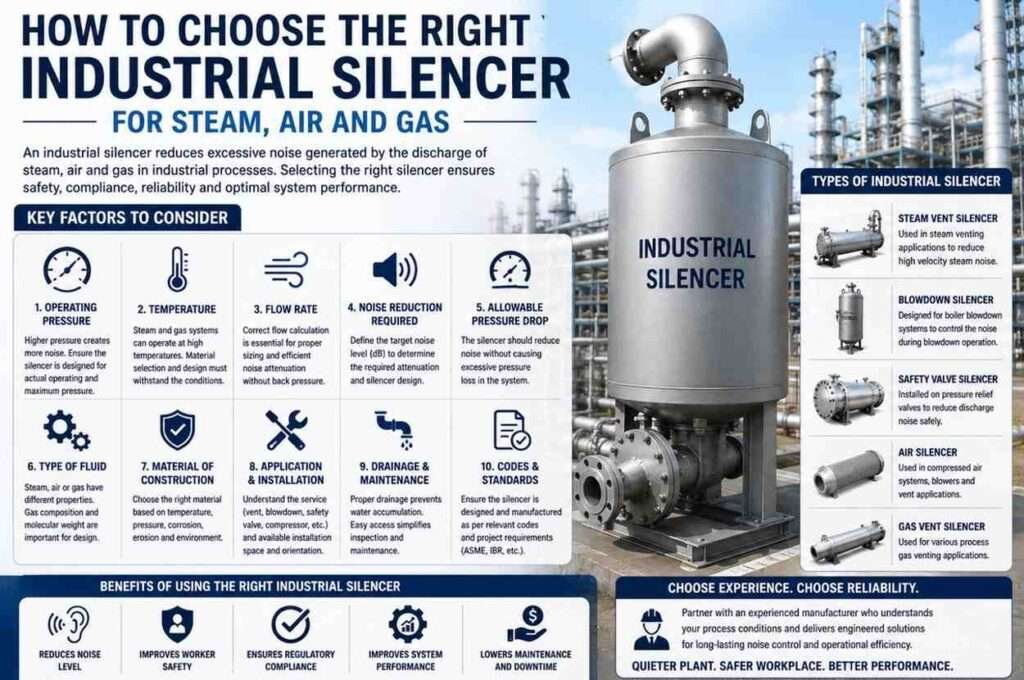
Industrial facilities often face an easy-to-miss challenge: too much noise from high-speed steam, air, and gas release. Whether it originates from a boiler vent, safety valve, compressor, process gas piping, pressure relief setup, or turbine bypass, unmanaged discharge noise can compromise employee safety, equipment dependability, and regulatory environmental compliance.
Selecting the appropriate industrial silencer is not just about picking a unit that matches the current pipe diameter. It needs to be designed specifically for the system’s real operating parameters, such as pressure, temperature, flow rate, gas composition, acceptable pressure loss, target noise attenuation, and the conditions of the installation site.
A correctly selected industrial silencer reduces acoustic energy while allowing the process fluid to flow safely and efficiently. An incorrectly selected unit can cause high back pressure, poor noise reduction, vibration, early wear, or weak performance.
This guide explains how to choose the right industrial silencer for steam, air, and gas uses. It covers key technical factors to consider. It also lists questions to ask a manufacturer before you place an order.
What Is an Industrial Silencer?
An industrial silencer is a noise-control device. It reduces sound from gases and fluids moving or discharging in industrial systems.
When a high-pressure fluid escapes through a valve, nozzle, vent, or pipeline, its pressure energy becomes kinetic energy. Rapid expansion and turbulence generate acoustic energy, resulting in high noise levels.
An industrial silencer controls this noise by managing the fluid’s:
- Pressure
- Velocity
- Turbulence
- Expansion
- Acoustic energy
Depending on the application, silencers may use reactive elements, absorptive materials, diffusers, expansion chambers, perforated plates, or combinations of these technologies.
Industrial silencers are commonly used for:
- Steam venting
- Boiler blowdown
- Safety valve discharge
- Compressed-air discharge
- Gas venting
- Process gas release
- Compressor suction and discharge
- Turbine bypass systems
- Fan and blower systems
- Engine exhaust systems
The fluid being handled heavily influences the correct design.
Why Is Choosing the Right Industrial Silencer Important?
Different fluids produce different acoustic and mechanical conditions. A silencer made for compressed air may not be suitable for high-temperature steam or corrosive process gas. The selection affects four major areas.
Worker Safety
Excessive industrial noise can contribute to hearing damage, fatigue, reduced concentration, and communication difficulties. Noise reduction at the source is generally more effective than relying exclusively on personal protective equipment.
Process Performance
A silencer must reduce noise without creating unacceptable pressure loss or interfering with process flow.
Equipment Reliability
Poorly designed silencers can contribute to excessive vibration, thermal stress, mechanical loading, or erosion.
Environmental Compliance
Plants located near populated areas may need to control noise emissions beyond the immediate work area.
For these reasons, engineers should treat silencer selection as an engineering decision rather than a standard pipe-fitting purchase.
Step 1: Identify the Fluid Being Discharged
The first question when selecting an industrial silencer is simple:
What fluid will pass through it?
The three major categories are steam, air, and gas.
Steam Silencers
Steam applications typically involve high pressure and high temperature. Examples include boiler startup vents, steam blowdown systems, safety valve discharge, turbine bypass systems, and steam blowing operations.
Steam silencers must account for:
- Steam pressure
- Steam temperature
- Mass flow rate
- Steam quality
- Pressure ratio
- Allowable back pressure
- Condensate formation
High-pressure steam can make a deafening noise as it flows. To reduce this noise, the pressure is often lowered in several stages. It also helps to use flow passages with a good design.
Air Silencers
Compressed-air systems are common throughout manufacturing facilities and process plants.
Industrial air silencers may be used for:
- Compressor discharge
- Air receiver venting
- Pneumatic systems
- Blow-off systems
- Air release valves
- Instrument-air systems
Although compressed air usually runs cooler than steam, it can still make loud noise. Pressure ratio and high discharge speed can cause this noise.
Gas Silencers
Gas applications require additional attention because the gas may be combustible, toxic, corrosive, or chemically reactive.
Applications can include:
- Natural gas venting
- Process gas discharge
- Hydrogen systems
- Nitrogen systems
- Flare-related applications
- Compressor systems
- Pressure relief systems
For gas service, the manufacturer needs accurate information about gas composition, molecular weight, density, temperature, pressure, and flow rate.
Material compatibility and hazardous-area requirements may also influence the design.
Step 2: Determine the Operating Pressure
Pressure is one of the most important parameters in industrial silencer selection.
A high-pressure fluid contains significant stored energy. When a valve or vent releases that energy, it can generate extremely high acoustic levels.
The manufacturer should know:
- Normal operating pressure
- Minimum pressure
- Maximum pressure
- Design pressure
- Upstream pressure
- Downstream pressure
For relief applications, the relationship between upstream pressure and downstream atmospheric pressure is particularly important.
A silencer designed without accurate pressure data may not achieve the required acoustic performance.
Step 3: Check the Operating Temperature
Temperature directly affects material selection, mechanical design, thermal expansion, insulation requirements, and service life.
For steam applications, temperatures significantly above normal ambient conditions may expose the silencer.
For gas systems, temperature can vary substantially depending on the process.
The design should therefore consider:
- Normal operating temperature
- Maximum operating temperature
- Minimum operating temperature
- Temperature cycling
- Thermal expansion
- Heat loss
Materials must retain their required mechanical properties at the operating temperature.
Step 4: Calculate the Flow Rate
Flow rate is essential for determining silencer size and internal geometry.
It may be expressed as:
- kg/h
- kg/s
- Nm³/h
- m³/h
- SCFM
- Actual volumetric flow rate
For gases, it is important to distinguish standard and actual volumetric flow rates. Gas volume changes a lot with pressure and temperature.
An undersized silencer may create excessive pressure drop and high outlet velocity.
An oversized silencer may provide little additional benefit while increasing equipment cost and installation requirements.
Therefore, you should base proper sizing on actual process conditions rather than on pipe diameter alone.
Step 5: Define the Required Noise Reduction
Before selecting an industrial silencer, establish the desired outlet noise level.
For example, a project may specify:
- Maximum sound pressure level at a defined distance
- Maximum allowable dB(A)
- Octave-band noise limits
- Workplace noise requirements
- Property-line noise limits
The required attenuation is determined by comparing the expected untreated noise level with the target level.
For example, a discharge source may produce about 140 dB. The target at a set location is 95 dB. So, strong noise reduction is needed.
The actual acoustic design should consider frequency, measurement distance, atmospheric conditions, and installation geometry rather than relying only on a single overall decibel number.
Step 6: Consider Allowable Pressure Drop
Noise reduction should never be considered independently from fluid dynamics.
Every silencer introduces some pressure loss. The objective is to achieve the required acoustic attenuation while keeping pressure drop within the limits of the process.
Excessive pressure drop can:
- Reduce system efficiency
- Affect valve performance
- Increase energy consumption
- Restrict required flow
- Interfere with pressure relief performance
This is particularly important for safety valve and pressure relief applications.
A properly engineered industrial silencer balances acoustic attenuation with acceptable pressure drop.
Step 7: Select the Appropriate Silencer Design
Different applications require different silencer configurations.
Steam Vent Silencers
Steam vent silencers are designed specifically for high-pressure steam discharge.
Typical applications include:
- Boiler startup vents
- Steam vent stacks
- Turbine bypass systems
- Safety valve discharge
- Steam blowing
They generally incorporate pressure-reduction and acoustic attenuation stages suitable for high-temperature service.
Blowdown Silencers
Blowdown silencers are commonly installed on boiler blowdown systems.
They control the noise that high-pressure steam and hot water generate when they discharge during boiler blowdown operations.
The design must account for both acoustic performance and the demanding thermal and flow conditions associated with blowdown.
Safety Valve Silencers
Safety valve silencers are installed downstream of pressure relief or safety valves.
Their primary purpose is to reduce discharge noise while ensuring that the relief system can perform its safety function.
Therefore, designers must carefully consider allowable back pressure when they design the silencer.
Compressed Air Silencers
Compressed-air silencers are used to reduce noise generated by rapid air discharge.
They are frequently used in:
- Manufacturing plants
- Pneumatic systems
- Compressor installations
- Air receiver systems
- Process equipment
Gas Vent Silencers
Gas vent silencers are designed for controlled noise reduction during gas discharge.
Depending on the gas and operating conditions, the design may require specialized materials, hazardous-service considerations, and customized acoustic treatment.
Step 8: Evaluate Material Selection
Material selection should be based on the actual process environment rather than cost alone.
Common materials include:
Carbon Steel
Suitable for many general industrial applications where corrosion and temperature conditions are moderate.
Stainless Steel
Often selected where corrosion resistance, cleanliness, or higher-temperature performance is important.
Alloy Steel
May be appropriate for demanding high-temperature and high-pressure applications.
Specialized Alloys
Certain aggressive or high-temperature gas services may require nickel-based or other specialized alloys.
Material selection should consider:
- Fluid chemistry
- Temperature
- Pressure
- Corrosion potential
- Erosion
- Moisture
- Outdoor exposure
- Design life
Step 9: Consider Installation Requirements
The physical installation location can influence the silencer design as much as the process conditions.
Before ordering, evaluate:
- Available space
- Vertical or horizontal installation
- Pipe routing
- Structural supports
- Access for maintenance
- Drainage
- Insulation
- Weather conditions
- Wind loading
- Transportation and lifting requirements
Large industrial silencers may require dedicated structural support. The support arrangement should account for equipment weight, operating loads, thermal expansion, and external forces.
Step 10: Consider Condensation and Drainage
Condensation can be an important issue in steam and certain gas applications.
If condensate accumulates inside the silencer, it may contribute to:
- Corrosion
- Increased weight
- Reduced performance
- Water hammer risk
- Internal damage
Properly designed drain connections and appropriate installation practices help prevent these problems.
For steam service, engineers should consider drainage provisions during the initial engineering stage rather than add them after installation.
What Information Should You Give an Industrial Silencer Manufacturer?
A manufacturer can provide a much more accurate design when complete process information is available.
Ideally, provide:
- Fluid name and composition
- Normal operating pressure
- Maximum operating pressure
- Normal and maximum temperature
- Flow rate
- Inlet pipe size
- Outlet requirements
- Required noise level
- Allowable pressure drop
- Installation orientation
- Operating frequency or duty cycle
- Applicable codes and project specifications
- Material requirements
- Site/environmental conditions
For gas applications, molecular weight, specific heat ratio, and gas density may also be required.
For steam applications, steam pressure, temperature, quality, and flow rate are particularly important.
The more accurate the process data, the more reliable the final silencer design.
Common Mistakes When Selecting an Industrial Silencer
Several mistakes repeatedly cause poor silencer performance.
Choosing Based Only on Pipe Size
Two systems with the same pipe diameter can have completely different pressure, temperature, and flow conditions.
Pipe size alone is therefore not sufficient for silencer selection.
Focusing Only on Decibel Reduction
A silencer that provides excellent acoustic attenuation but creates unacceptable pressure drop may not be suitable for the process.
Evaluate acoustic and fluid-dynamic performance together.
Ignoring Operating Conditions
Using normal operating conditions while ignoring maximum pressure, maximum temperature, or emergency flow conditions can lead to an unsuitable design.
Selecting the Cheapest Option
Initial purchase price should not be the only selection criterion. Material quality, engineering, acoustic performance, service life, maintenance, and total cost of ownership are also important.
Neglecting Maintenance Access
A silencer that cannot be inspected or maintained easily may become a long-term operational problem.
Industrial Silencer Selection Checklist
Before finalizing your purchase, verify the following:
| Parameter | What to Check |
|---|---|
| Fluid | Steam, air, natural gas, process gas, etc. |
| Pressure | Normal and maximum pressure |
| Temperature | Normal and maximum temperature |
| Flow | Mass or volumetric flow rate |
| Noise | Existing and required sound levels |
| Pressure Drop | Maximum allowable pressure loss |
| Material | Compatibility with process conditions |
| Installation | Orientation and available space |
| Drainage | Condensate removal requirements |
| Supports | Structural and thermal loads |
| Maintenance | Inspection and cleaning access |
| Standards | Applicable project and engineering requirements |
This checklist helps buyers and engineers compare different industrial silencer proposals more effectively.
Why Custom-Engineered Industrial Silencers Are Often Better
Standard products can work for simple applications, but demanding industrial systems frequently require customized engineering.
A custom industrial silencer can be designed around the actual:
- Pressure
- Temperature
- Flow rate
- Fluid properties
- Noise target
- Pressure-drop limit
- Installation configuration
- Material requirements
This approach can improve acoustic performance while avoiding unnecessary oversizing and excessive pressure loss.
For complex applications, manufacturers may also evaluate acoustic calculations, flow distribution, mechanical loads, thermal expansion, structural supports, and expected operating cycles.
How to Choose an Industrial Silencer Manufacturer
Choosing the manufacturer is an important part of the purchasing decision.
Look for a company with experience in the specific application rather than simply a company that supplies generic silencers.
Evaluate:
Engineering Capability
Can the manufacturer calculate acoustic performance, pressure drop, flow conditions, and mechanical requirements?
Manufacturing Capability
Does the manufacturer have suitable fabrication, welding, inspection, and quality-control capabilities?
Material Traceability
Can the manufacturer provide appropriate material certificates and quality documentation?
Application Experience
Has the manufacturer supplied silencers for similar steam, air, or gas applications?
Customization
Can the manufacturer adapt the design to project-specific operating conditions?
Documentation
Depending on the project, required documentation may include drawings, calculations, material certificates, inspection records, test reports, and other quality documents.
Anpam Engineering Industrial Silencer Solutions
Anpam Engineering Industrial silencer manufacturers engineer solutions for steam, air, and gas applications across demanding process industries.
The product range can include solutions such as:
- Steam vent silencers
- Blowdown silencers
- Startup vent silencers
- Warm-up vent silencers
- Safety valve silencers
- Blow-off silencers
- Gas vent silencers
- Process gas vent silencers
- Air vent silencers
- Engine exhaust silencers
The appropriate configuration can be developed based on the project’s operating pressure, temperature, flow rate, noise requirements, material specifications, and installation conditions.
For industrial buyers, the key advantage of an engineered approach is this. The silencer is chosen for the process, not just the pipe connection.
Frequently Asked Questions
What is an industrial silencer?
An industrial silencer is a noise control device. It reduces sound from high-speed steam, air, or gas discharge in industrial systems.
How do I choose the right industrial silencer?
Start by identifying the fluid, pressure, temperature, flow rate, required noise reduction, allowable pressure drop, material requirements, and installation conditions. These parameters determine the appropriate silencer design.
What is the difference between a steam silencer and a gas silencer?
Steam silencers are made for hot steam service, often under high pressure. Gas silencers must also consider gas properties like molecular weight, density, composition, temperature, and pressure. The internal design and material selection can therefore differ significantly.
Can you use one industrial silencer for steam, air, and gas?
Not always. Every application comes with distinct thermodynamic, acoustic, mechanical, and material needs. A silencer should be chosen or designed according to the particular fluid and operating conditions.
Does an industrial silencer reduce pressure?
Engineers primarily design a silencer to reduce noise, but it inevitably causes some pressure drop. The design objective is to keep this pressure loss within the allowable limit for the system.
What information do you need to size a silencer?
Typical information includes fluid type, pressure, temperature, flow rate, pipe size, required noise level, allowable pressure drop, installation configuration, and applicable project specifications.
Where are industrial silencers used?
They are used in power plants, oil and gas facilities, refineries, petrochemical plants, chemical industries, manufacturing facilities, process plants, and other industrial installations where high-velocity fluid discharge creates excessive noise.
Conclusion
Choosing the right industrial silencer requires more than matching a product to a pipeline connection. The best solution considers the full operating environment, from fluid and pressure to temperature and flow rate. It also includes acoustic needs, pressure drop, material compatibility, and installation conditions.
Steam applications require careful consideration of pressure reduction and high-temperature construction. In compressed-air applications, discharge velocity and flow characteristics strongly influence noise generation. For gas applications, factors such as gas composition, molecular properties, corrosion resistance, hazardous-service conditions, and operating pressure may be particularly important.
A well-engineered industrial silencer should provide the required noise attenuation without compromising process performance or safety.
If you are planning a new installation, replacing an existing silencer, or trying to reduce excessive steam, air, or gas discharge noise, providing accurate operating data to an experienced manufacturer is the best starting point.
The right silencer is not simply the quietest one—it is the one that achieves the required acoustic performance while maintaining safe, reliable, and efficient process operation.

