




 blog
blog
What is a Heat Exchanger?
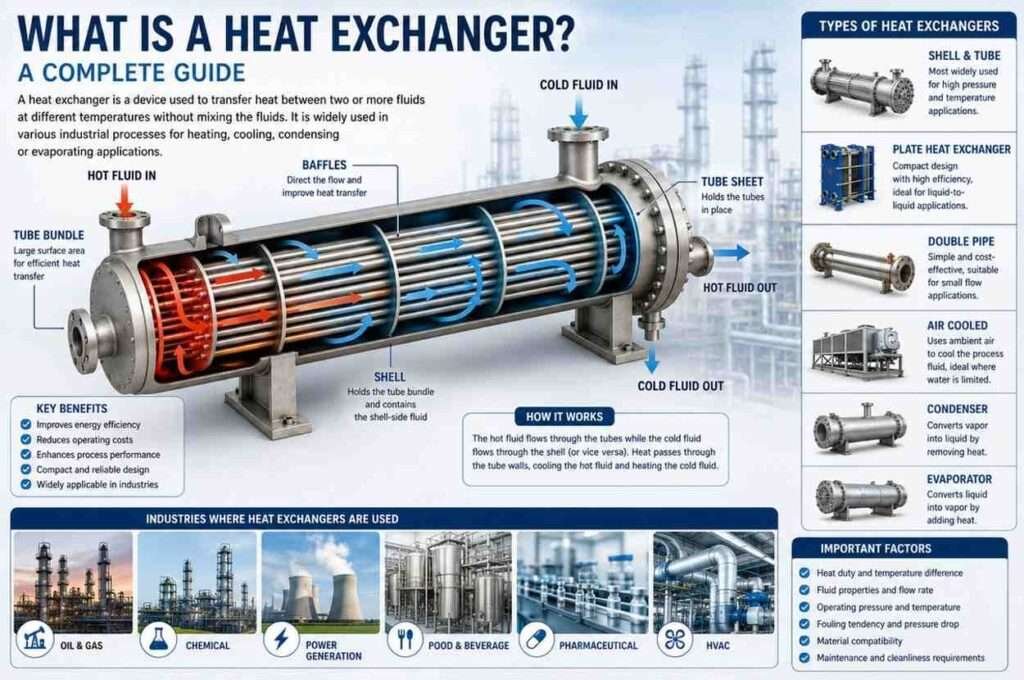
A heat exchanger is an industrial device used to transfer heat from one fluid to another without necessarily allowing the two fluids to mix. Heat exchangers are fundamental to modern industrial processes because they allow plants to recover, add, remove, or control thermal energy efficiently.
They are found in power plants, refineries, chemical processing facilities, food and beverage plants, pharmaceutical manufacturing, HVAC systems, oil and gas facilities, and many other industries. From cooling engine oil to heating process fluids and condensing steam, heat exchangers perform a wide range of thermal duties.
Understanding how a heat exchanger works is important when selecting equipment for a new process, replacing an existing unit, or improving plant energy efficiency. The right design can reduce energy consumption, improve process stability, protect equipment, and lower operating costs.
This complete guide explains what a heat exchanger is, how it works, the major types of heat exchangers, their applications, important design considerations, and how to select the right unit for an industrial process.
What Is a Heat Exchanger?
A heat exchanger is thermal equipment that transfers heat between two or more fluids at different temperatures.
The fluids may be:
- Liquid to liquid
- Gas to liquid
- Gas to gas
- Steam to liquid
- Steam to gas
In many industrial heat exchangers, the hot and cold fluids remain physically separated by a metal wall. Heat travels from the hotter fluid through the heat-transfer surface and into the colder fluid.
For example, imagine hot process water that must cool before it moves to the next manufacturing step. Rather than blending the hot stream with cooling water, a heat exchanger keeps both flows separate while transferring heat from one to the other.
This controlled heat transfer makes industrial processes safer, more efficient, and easier to manage.
How Does a Heat Exchanger Work?
A heat exchanger operates on the principle of a temperature difference.
Heat naturally moves from a higher-temperature region toward a lower-temperature region. A heat exchanger provides a controlled surface through which this thermal energy can move.
A typical process follows these stages:
1. Hot Fluid Enters
The hot process fluid enters the heat exchanger through one inlet connection.
2. Cold Fluid Enters
A second fluid, which has a lower temperature, enters through another connection.
3. Heat Transfer Takes Place
The two fluids flow through separate passages. Heat moves from the hot fluid through the separating wall and into the colder fluid.
4. Temperature Changes
The hot fluid leaves at a lower temperature, while the cold fluid leaves at a higher temperature.
5. Fluids Exit Separately
The two fluids remain separated and continue to their respective process systems.
The efficiency of this process depends on heat-transfer area and temperature difference. It also depends on fluid properties, flow arrangement, and material selection. Fouling and flow velocity can also affect efficiency.
Main Types of Heat Exchangers
Heat exchangers are available in different configurations because industrial processes have different thermal requirements. The best type depends on the fluid, pressure, temperature, flow rate, and available space. It also depends on maintenance needs and required heat-transfer performance.
1. Shell and Tube Heat Exchanger
A shell and tube heat exchanger is one of the most widely used designs in industrial applications.
It consists of a bundle of tubes installed inside a larger cylindrical shell. One fluid flows through the tubes while the other flows around the outside the tubes within the shell.
Engineers often install baffles inside the shell to direct fluid flow across the tube bundle and improve heat transfer.
Advantages
- Suitable for high-pressure applications
- Handles high temperatures
- Robust construction
- Suitable for many industrial fluids
- Relatively easy to customize
- Available in different materials and configurations
Shell and tube heat exchangers are common in oil refineries and chemical plants. Power plants, petrochemical facilities, and other process industries also use them.
2. Plate Heat Exchanger
A plate heat exchanger uses a series of thin, corrugated metal plates arranged to create alternating flow channels.
One fluid flows through one set of channels while the other fluid flows through the adjacent channels. The large surface area of the plates allows efficient heat transfer.
Advantages
- Compact design
- High heat-transfer efficiency
- Relatively small footprint
- Easy capacity expansion in many designs
- Suitable for many liquid-to-liquid applications
Plate heat exchangers are commonly used in HVAC, food processing, pharmaceutical, chemical, and general process applications.
3. Double Pipe Heat Exchanger
A double pipe heat exchanger is among the simplest heat exchanger designs.
One pipe sits inside another pipe. One fluid flows through the inner pipe while the second fluid flows through the annular space between the two pipes.
This configuration is particularly useful for relatively small heat duties and applications where simplicity is important.
Advantages
- Simple construction
- Easy to understand and operate
- Suitable for smaller capacities
- Flexible configuration
- Relatively straightforward maintenance
4. Air-Cooled Heat Exchanger
An air-cooled heat exchanger relies on surrounding air, rather than cooling water, to draw heat away from a process fluid.
Fans move air across finned tubes, allowing heat to transfer from the process fluid to the surrounding atmosphere.
Air-cooled heat exchangers are especially useful in locations where cooling water is limited, expensive, or difficult to obtain.
They are commonly used in:
- Refineries
- Petrochemical plants
- Power plants
- Gas processing facilities
- Remote industrial facilities
5. Condensers
A condenser is a specialized heat exchanger used to convert vapor into liquid by removing heat.
Steam condensers are particularly important in power generation. A cooling system cools exhaust steam from a turbine until it condenses into water. The process then reuses the water.
Refrigeration, chemical processing, distillation, and other applications involving vapor-liquid phase changes also use condensers.
6. Evaporators
An evaporator performs the opposite thermal duty. It transfers heat into a liquid to produce vapor.
Evaporators are commonly found in:
- Chemical processing
- Food manufacturing
- Pharmaceutical production
- Refrigeration systems
- Water treatment
The design depends heavily on the fluid characteristics, boiling point, pressure, and required evaporation rate.
Common Heat Exchanger Flow Arrangements
The way fluids move through a heat exchanger has a significant effect on thermal performance.
Parallel Flow
In a parallel-flow arrangement, both fluids enter from the same end and move in the same general direction.
The temperature difference is generally greatest near the inlet and decreases along the heat exchanger.
Although simple, parallel flow is often less thermally efficient than counterflow for many applications.
Counterflow
In counterflow operation, the two fluids move in opposite directions.
This setup keeps a better temperature difference across the heat-transfer surface. Engineers widely use it when they need high thermal efficiency.
Counterflow designs can achieve strong heat recovery while maintaining a compact heat-transfer area.
Crossflow
In crossflow arrangements, one fluid flows across the other fluid’s flow path, usually at approximately right angles.
Air-cooled and finned heat exchanger applications frequently use crossflow designs.
What Determines Heat Exchanger Performance?
Several engineering parameters determine how effectively a heat exchanger performs.
Temperature Difference
A greater temperature difference generally provides a stronger driving force for heat transfer.
Engineers often evaluate the log mean temperature difference (LMTD) when designing or analyzing heat exchangers.
Heat Transfer Area
A larger heat-transfer surface generally transfers more thermal energy.
However, increasing surface area also increases equipment size and potentially project cost. Therefore, the design must balance thermal performance with economic and physical constraints.
Fluid Flow Rate
Flow rate affects both heat-transfer performance and pressure drop.
If flow velocity is too low, heat transfer may become inefficient and fouling may increase. If velocity is too high, pressure drop and erosion risks may increase.
Fluid Properties
The thermal conductivity, viscosity, density, specific heat, and phase behavior of the fluids all influence heat exchanger design.
Engineers must understand the actual process fluids rather than selecting equipment based solely on temperature and pressure.
Fouling
Fouling occurs when unwanted deposits accumulate on heat-transfer surfaces.
Common fouling materials include:
- Scale
- Sediment
- Corrosion products
- Biological deposits
- Process residues
Fouling adds thermal resistance and can reduce heat-transfer performance while increasing pressure drop.
Heat Exchanger Materials
Material selection is critical because industrial heat exchangers may operate under high pressure, high temperature, corrosive conditions, or combinations of these factors.
Common materials include:
Carbon Steel
Carbon steel is widely used where the process environment permits it and cost-effective construction is required.
Stainless Steel
Stainless steel provides improved corrosion resistance and is commonly used in chemical, food, pharmaceutical, and process applications.
Alloy Steel
Alloy steels may be selected for higher-temperature or more demanding applications where enhanced mechanical properties are required.
Nickel-Based Alloys
For highly corrosive or high-temperature services, specialized nickel-based alloys may be considered.
Base material selection on the actual fluid chemistry, pressure, temperature, corrosion conditions, mechanical requirements, and applicable design specifications.
Where Are Heat Exchangers Used?
The versatility of heat exchangers makes them essential across numerous industries.
Oil and Gas
Heat exchangers are used for crude oil heating and cooling, gas processing, condensation, reboiling, and process heat recovery.
Petrochemical
Petrochemical plants use heat exchangers throughout reaction, separation, heating, cooling, and condensation processes.
Power Generation
Power plants use heat exchangers in boilers, condensers, feedwater systems, cooling systems, and auxiliary processes.
Chemical Processing
Chemical facilities rely on heat exchangers for temperature control during reactions, distillation, evaporation, condensation, and product cooling.
Food and Beverage
Heat exchangers are used for pasteurization, sterilization, heating, cooling, and temperature control.
Pharmaceutical
Controlled and hygienic heat transfer is essential for many pharmaceutical manufacturing processes.
HVAC and Refrigeration
Heat exchangers are fundamental to heating, cooling, refrigeration, and air-conditioning systems.
How to Select the Right Heat Exchanger
Selecting a heat exchanger should start with the process needs, not with the most popular equipment type.
Important parameters include:
1. Heat Duty
Determine how much heat must be transferred, typically expressed in units such as kW or MW.
2. Fluid Type
Identify both hot and cold fluids, including their chemical composition and phase.
3. Operating Pressure
Maximum and normal operating pressures influence mechanical design and material requirements.
4. Operating Temperature
Normal, minimum, and maximum temperatures should be considered.
5. Flow Rate
Accurate mass or volumetric flow rates are necessary for proper thermal and hydraulic sizing.
6. Allowable Pressure Drop
The heat exchanger should provide the required thermal performance without causing excessive pressure loss.
7. Fouling Potential
Processes involving scaling, suspended solids, or viscous fluids may require additional heat-transfer area and easier cleaning access.
8. Maintenance Requirements
Consider whether the unit needs to be frequently opened, cleaned, inspected, or repaired.
9. Installation Space
Available footprint, orientation, nozzle locations, and access requirements can influence the final configuration.
Heat Exchanger Maintenance
Regular maintenance is essential for maintaining heat-transfer efficiency and preventing unexpected shutdowns.
Common maintenance activities include:
- Monitoring inlet and outlet temperatures
- Checking pressure drop
- Inspecting for leaks
- Cleaning heat-transfer surfaces
- Monitoring corrosion and erosion
- Checking tube integrity in shell and tube units
- Inspecting gaskets in gasketed plate heat exchangers
- Monitoring vibration where applicable
A slow increase in pressure drop can be an early sign of fouling. It can also indicate a blockage. It may also point to mechanical problems. A drop in thermal performance can be another early warning sign.
Preventive maintenance addresses these issues before they significantly affect production.
Why Heat Exchanger Efficiency Matters
Energy efficiency is one of the biggest reasons industries invest in properly designed heat exchangers.
A well-designed heat exchanger can recover waste heat from one process and reuse it elsewhere. This reduces the amount of external energy required for heating or cooling.
For example, one operation can use hot exhaust or fluid from another operation to preheat an incoming stream.
This approach can:
- Reduce fuel consumption
- Lower cooling requirements
- Improve overall process efficiency
- Reduce operating costs
- Support energy conservation goals
- Reduce unnecessary heat rejection
Heat recovery therefore plays an important role in modern industrial energy management.
Common Heat Exchanger Problems
Even a well-designed heat exchanger can experience performance problems during operation.
Fouling
Deposits reduce heat-transfer efficiency and increase pressure drop.
Corrosion
Chemical attack can damage tubes, plates, shells, and other components.
Erosion
High fluid velocities or suspended particles can gradually wear heat-transfer surfaces.
Leakage
Tube failures, gasket damage, or corrosion can allow fluids to mix or escape.
Thermal Stress
Repeated heating and cooling cycles can cause expansion and contraction, potentially contributing to fatigue.
Vibration
Flow-induced vibration can damage tubes and other components if not properly controlled.
Regular monitoring helps detect these issues early.
Conclusion
A heat exchanger is one of the most important pieces of equipment in modern industrial processing. Its main purpose is simple: move heat from one fluid to another. But reliable, efficient heat transfer still needs careful engineering.
From shell-and-tube heat exchangers and plate-type units to double-pipe configurations and air-cooled designs, there are many options. Each option has clear benefits. Each one also fits specific applications. The best choice depends on heat load, fluid properties, and pressure and temperature limits. It also depends on flow rate, fouling risk, allowed pressure drop, maintenance needs, and available space.
For industrial buyers and engineers, selecting the right heat exchanger is not simply about purchasing equipment with a particular capacity. It requires understanding the complete thermal and mechanical requirements of the process.
A properly engineered heat exchanger can improve process stability, recover valuable energy, reduce operating costs, and extend equipment life. As industries continue to focus on energy efficiency and sustainable manufacturing, reliable heat-transfer equipment will remain a critical part of industrial process design.
Frequently Asked Questions
What is a heat exchanger?
A heat exchanger transfers heat between two or more fluids at different temperatures. It usually keeps the fluids physically separated.
What is the most common type of heat exchanger?
The shell and tube heat exchanger is widely used in industry because it can handle high pressure and temperature.
What are the main types of heat exchangers?
Common types include shell and tube, plate, double pipe, air-cooled heat exchangers, condensers, and evaporators.
What factors affect heat exchanger efficiency?
Temperature difference, heat-transfer area, fluid velocity, fluid properties, flow arrangement, fouling, and pressure drop all affect performance.
Why does a heat exchanger need maintenance?
Fouling, corrosion, erosion, leakage, and mechanical damage can reduce thermal performance. Regular inspection and cleaning help maintain efficiency and reliability.
How do I choose a heat exchanger for an industrial application?
Start with heat duty and fluid type. Note the flow rate. Record operating pressure and temperature. Set the allowable pressure drop. Review fouling characteristics. Confirm material compatibility. Define maintenance requirements. Check available installation space.